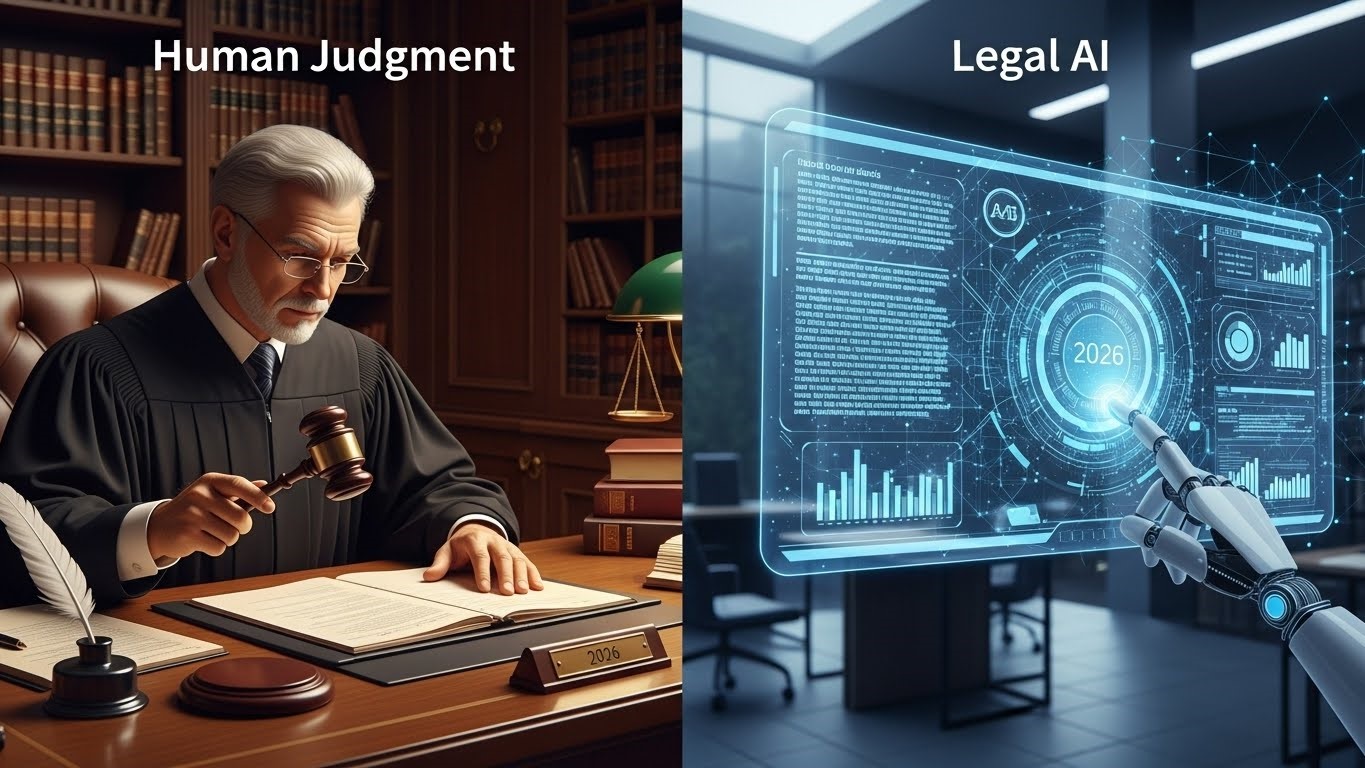
Artificial Intelligence is no longer optional in the legal sector. By 2026, legal AI will be a core part of how law firms, in-house counsel, and compliance teams operate. From legal research to contract review and dispute preparation, AI for legal work is reshaping how decisions are made and services are delivered.
Yet the most important debate remains unresolved:
Can legal AI replace human judgment?
The short answer is no.
The meaningful shift in 2026 will not be about replacing lawyers but enhancing them. AI will become a powerful assistant rather than a decision-maker.
What Human Judgment Brings to Legal AI Workflows
Even as legal AI grows smarter, the practice of law remains deeply human.
Human judgment includes interpretation, ethical reasoning, experience, and emotional intelligence. Lawyers do not just apply legal rules. They counsel clients, anticipate outcomes, and make complex decisions that involve financial risk, public perception, and emotional stakes.
AI for legal processes can review contracts and search for case law, but it cannot replace:
- Judgment in legal strategy
- Ethical decision-making
- Client trust
- Interpretation of intent
- Negotiation dynamics
By 2026, lawyers who use legal AI effectively will focus more on advisory roles while AI manages documentation and research.
What Legal AI Brings in 2026
Legal AI excels at scale, speed, and consistency.
AI for legal operations can process thousands of documents, scan court decisions, identify clause risks, and surface compliance issues in minutes.
Legal AI will continue improving in:
- Case law analysis
- Contract drafting and review
- Litigation analytics
- Regulatory tracking
- Document classification
- Legal reporting
The true strength of legal AI is that it reduces time spent on repetitive tasks and returns hours back to lawyers.
Where Legal AI Outperforms Humans
Legal AI is strongest where volume and repetition dominate.
Examples include:
- Contract review automation
- Document discovery
- Legal research databases
- Compliance monitoring
- Risk flagging
- Data-heavy litigation analysis
A task that may take a legal team days can take seconds with AI for legal work.
Where Human Judgment Still Wins
Legal AI does not understand nuance.
It cannot:
- Read emotional cues
- Manipulate courtroom strategy
- Apply moral logic
- Negotiate with empathy
- Interpret ambiguity with intent
Human judgment remains central in:
- Complex litigation
- Advisory matters
- High-stakes negotiations
- Sensitive disputes
- Client counseling
In 2026, legal AI will provide information but not authority.
How AI for Legal Will Reshape Legal Roles
Law firm roles will evolve significantly.
Junior lawyers will rely on legal AI for research and spend more time on case strategy. Paralegals will move into legal operations roles. Senior lawyers will drive strategy and client engagement rather than documentation.
New roles will emerge:
- Legal AI Analyst
- Legal Technology Manager
- Compliance Automation Specialist
- AI Risk Consultant
Legal AI will not eliminate jobs. It will elevate them.
Risks and Ethics in Legal AI Adoption
Legal AI comes with responsibility.
By 2026, firms will implement governance policies covering:
- Accuracy validation
- Bias monitoring
- Data privacy
- Human oversight
- Client disclosures
Using AI for legal work does not remove ethical duty from lawyers. It increases it.
The Future Is Hybrid Law
The strongest firms will be those that integrate legal AI into everyday work.
They will deliver:
- Faster turnaround
- Lower costs
- Data-driven insights
- Transparent billing
- Predictable outcomes
The future lawyer is not replaced by legal AI.
The future lawyer is powered by it.
Conclusion
Legal AI will dominate workflows by 2026.
But human judgment will continue to dominate decisions.
AI for legal services brings intelligence.
Lawyers bring wisdom.
The difference will define winners in the legal industry.