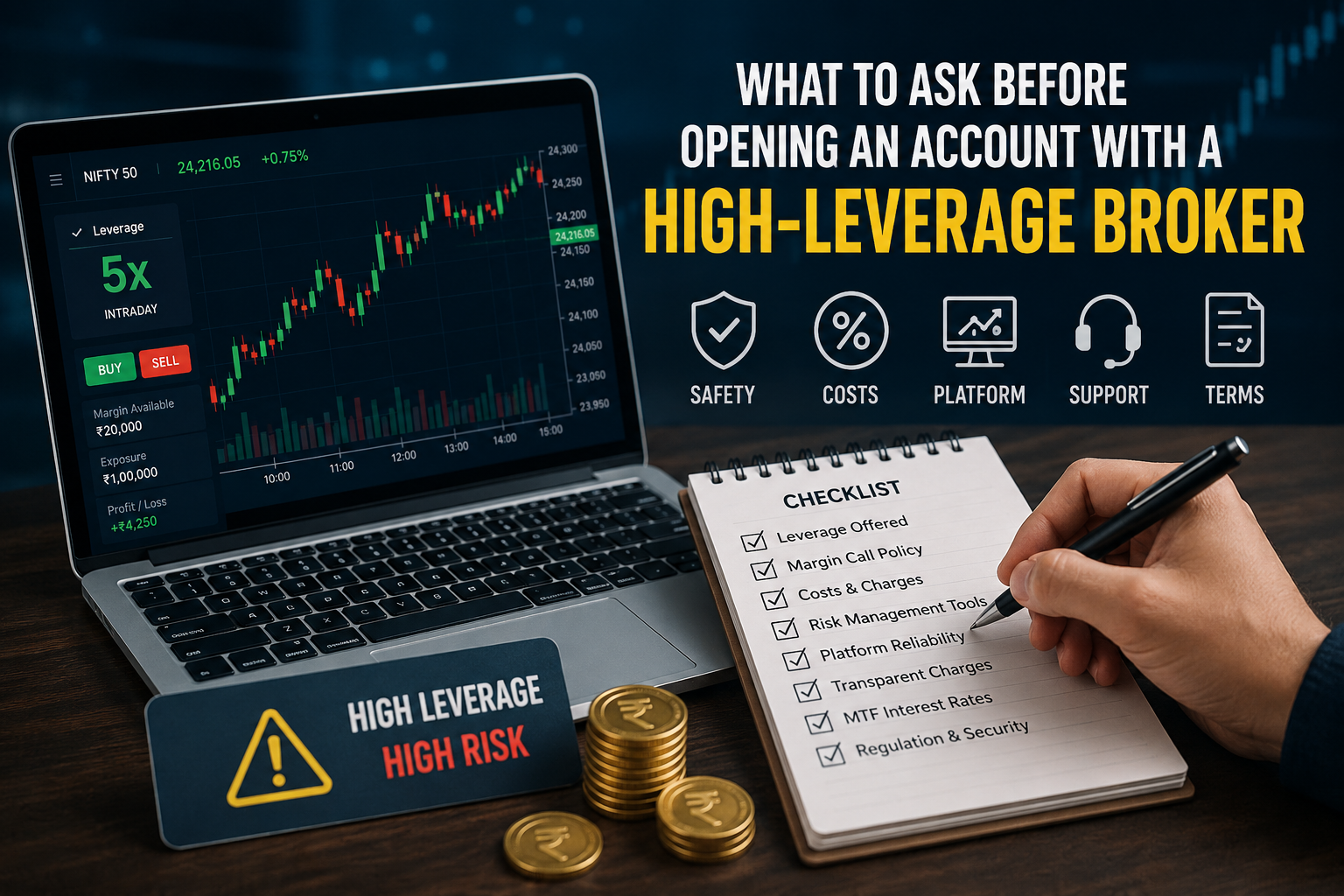
The promise of bigger trades with less capital often attracts traders towards leveraged trading. It sounds simple on paper. Put in a smaller amount of money and gain exposure to a much larger position.
However, leverage can work both ways. While profits may increase, losses can grow just as quickly. This is why selecting the right broker for your trading needs becomes really important. Selecting the right trader will help you to avoid loss situations to a great extent.
Many traders searching for the highest leverage broker in India focus on the leverage number itself. In reality, that should be only one part of the decision. The broker’s policies, costs, platform, and support can have a great impact on your trading experience.
So, when you plan to open a trading account with any of the high-leverage brokers, you must ask some of the common questions to avoid uncertainty. Read this guide to know the details.
What Is A High-Leverage Broker?
A high-leverage broker allows traders to take positions that are larger than the money available in their trading account. The broker provides additional exposure through margin. This helps the traders to participate in bigger trades.
For example, if you have ₹20,000 and receive 5x leverage, you can take a position worth ₹1,00,000. If the trade moves in your favour, returns can be higher. If the market moves against you, losses can also increase at the same pace.
This is why leverage should be viewed as a tool and not a shortcut to higher profits.
Things To Ask Before Opening An Account With A High-Leverage Broker
As a trader who is planning to open an account with a high-leverage broker, there are certain questions that you should address. The most common questions that you should try to get the answers to are as follows:
1. How Much Leverage Will You Actually Get?
Advertisements often highlight the maximum leverage available. What matters more is the leverage you can actually use for the products you trade.
A broker may offer one level of leverage for intraday equity trades and a completely different level for derivatives or commodities. There may also be restrictions based on market conditions or specific stocks.
Before opening an account, understand where the leverage applies. See if this is what you need as per your trading style.
2. What Happens If The Trade Goes Wrong?
This is a question many traders forget to ask.
Markets do not move in one direction forever. At some point, every trader faces a losing position. What matters is how the broker handles that situation.
Find out when margin calls are triggered. Understand how you will be notified and whether positions can be squared off automatically. A clear understanding of these rules can prevent unnecessary surprises during volatile market sessions.
3. What Will Leverage Actually Cost You?
Leverage is not just about access to larger positions. There is usually a cost attached to it.
Some traders realise this only after checking their statements. Interest charges, funding costs, and carrying expenses are some of the factors that impact your slowly.
Ask for a complete breakdown of all costs before opening the account. A broker with slightly lower leverage but better pricing may be a more practical choice over time.
4. Are Risk Management Features Available?
Good traders focus on risk first and returns later.
A broker should provide tools that help you control losses. This will help you to manage positions effectively. You must look for some of the basic features such as stop-loss orders, trailing stop-losses, margin calculators, and position monitoring. They can make a significant difference during fast-moving markets.
The availability of these tools often says more about a platform than the leverage being offered.
5. Is The Trading Platform Reliable?
A trading platform may seem impressive during a demo. This is true, but your focus should be on the reliability.
Imagine finding the perfect entry or exit only to face delays while placing an order. Technical issues become even more important when trading with leverage because every minute can affect the outcome of a trade.
Spend some time reviewing the platform and mobile app. Here, you must focus on the charting features and order execution quality a lot. This should be done before making a decision.
6. Are The Charges Easy To Understand?
The best brokers are usually the ones who explain their charges clearly. They will share everything with you initially. This will include all the type pf charges like maintenance charges, transaction fees, call-and-trade charges, or other costs. None of these is necessarily a problem if they are disclosed upfront.
Transparency helps build trust and makes it easier to estimate your actual trading costs.
7. Does The Broker Offer Margin Trading Facility?
If you plan to buy stocks using borrowed funds, the Margin Trading Facility becomes an important consideration.
Many investors compare brokers to find the lowest MTF interest rate broker because financing costs directly affect overall returns. While interest rates matter, they should not be viewed in isolation.
The list of eligible stocks, funding limits, ease of use, and support quality are equally important. A slightly higher rate may still be worthwhile if the overall experience is better.
8. How Strong Is The Broker’s Compliance And Investor Protection Framework?
You all must have heard that building trust takes time, and losing it is just a matter of seconds.
Before opening an account, check whether the broker follows regulatory requirements properly. Know if there is a system in place to protect client funds and data.
You should feel confident about where your money is being held and how your account is being managed. Strong compliance standards often indicate a broker that takes investor protection seriously.
Conclusion
The excitement of higher leverage can sometimes make traders overlook the basics. But in most cases, the quality of the broker matters far more than the leverage being offered. This is where the trade-off needs to be worked on. If you can do this, it will allow you to place better trades and even earn well.
If you’re evaluating different brokers, then ensure you do it deeply. Take your time to understand the pros and cons of each before making a final call. You must also put a deeper focus on what people who are already using these suggest.