Why Good Intentions Often Collapse Under Pressure
Many habits work well when life is calm. You plan to exercise, eat better, stay organized, or keep up with responsibilities. For a while, everything feels manageable. Then stress appears. Work becomes intense, deadlines stack up, and energy starts to fade. Suddenly the habits that once felt easy begin to disappear.
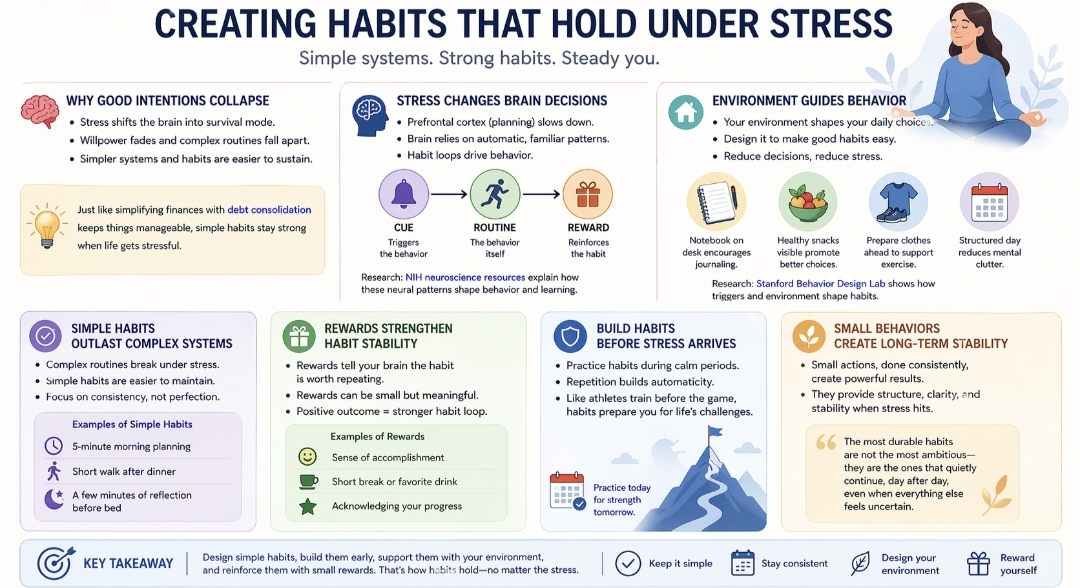
This pattern is common because many habits rely heavily on motivation and willpower. When conditions are comfortable, willpower can carry you through. Under pressure, however, the brain shifts into survival mode. Decisions become faster and more automatic, and complex routines often fall apart.
A more reliable approach focuses on building habits that continue functioning even when stress rises. Instead of depending on motivation, these habits are designed to run almost automatically. They are simple, connected to everyday cues, and structured to reduce mental effort.
You can see a similar approach in situations where people simplify complex systems so they remain manageable during difficult moments. Financial planning offers a useful example. Someone managing multiple financial obligations may consider options like debt consolidation in order to reduce complexity and create a clearer structure. Simplifying the system helps it remain manageable even during stressful periods.
Habits work in much the same way. The simpler the structure, the more likely the behavior will continue when life becomes demanding.
Stress Changes How the Brain Makes Decisions
To understand why habits break under pressure, it helps to look at how the brain responds to stress.
When stress levels rise, the brain prioritizes efficiency. The prefrontal cortex, which handles careful decision making and planning, becomes less active. At the same time, older brain systems responsible for automatic behavior take over.
In simple terms, the brain starts relying on patterns it already knows.
This is why people often revert to familiar behaviors when they feel overwhelmed. If healthy routines are not deeply embedded, the brain defaults to easier or more comforting patterns.
Neuroscience research often describes this process through the concept of habit loops. A habit loop includes a cue that triggers behavior, the routine that follows, and a reward that reinforces the action. Understanding this cycle helps explain why consistent habits become powerful over time. The National Institutes of Health has explored how these neural patterns shape behavior and learning. Their research on habit formation can be found through the NIH neuroscience resources.
When habits are designed around clear cues and simple routines, they are far more likely to survive stressful conditions.
Environment Often Matters More Than Willpower
Many people assume that strong habits come from strong discipline. While discipline can help, the environment often plays a much larger role than people realize.
Environmental cues quietly guide behavior throughout the day. The placement of objects, the structure of a schedule, and even the layout of a workspace influence what actions feel easiest.
For example, placing a notebook on a desk can make journaling more likely. Keeping healthy snacks visible can encourage better eating habits. Preparing exercise clothes ahead of time can increase the chances of staying active.
These environmental cues reduce the need for decision making. When stress rises, the brain tends to follow the path that requires the least mental effort. Designing the environment intentionally helps guide that path.
Behavioral scientists frequently highlight how small environmental adjustments can create powerful behavior changes. The Stanford Behavior Design Lab studies how habits develop through simple triggers and accessible actions. Their research on behavior design explains how environment and cues shape daily behavior patterns. You can explore these insights through the Stanford Behavior Design Lab resources.
When the environment supports the habit, the brain does not have to work as hard to maintain it.
Simple Habits Outlast Complex Systems
One of the most common mistakes people make when building habits is trying to change too much at once. They create complicated routines that require significant time, energy, or planning.
Under ideal conditions, those routines might work. Under stress, they become difficult to maintain.
Simple habits are far more durable.
A five minute planning session each morning can be easier to sustain than a detailed productivity system. A short walk after dinner may survive stressful weeks better than an elaborate workout schedule.
The goal is not to create impressive routines. The goal is to create behaviors that continue functioning when life becomes unpredictable.
Simple habits reduce cognitive load, which means the brain spends less energy deciding whether to act. Instead, the behavior becomes part of the daily rhythm.
Rewards Strengthen Habit Stability
Another important component of resilient habits is the reward that follows the behavior.
Rewards signal to the brain that a routine is worth repeating. Without a reward, habits struggle to stick.
The reward does not have to be dramatic. Sometimes it is simply the satisfaction of completing a task or the sense of relief that comes from staying organized.
Other times the reward can be more tangible, such as taking a short break, enjoying a favorite activity, or acknowledging progress.
When the brain begins associating a positive outcome with a specific routine, the habit loop becomes stronger. Over time, the cue alone can trigger the behavior automatically.
This automatic response is what allows habits to continue functioning even during stressful periods.
Resilient Habits Are Built Before Stress Arrives
The most reliable habits are established before life becomes chaotic. Practicing routines during calm periods allows them to become familiar and automatic.
When stress eventually appears, those routines already exist in the brain’s memory systems. Instead of requiring effort, they feel like the natural next step.
This is similar to how athletes train specific movements repeatedly so they can perform them instinctively during competition. The preparation allows performance to remain stable under pressure.
In everyday life, habits serve a similar purpose. They create stability when circumstances become unpredictable.
Small Behaviors Create Long Term Stability
Building habits that hold under stress does not require dramatic lifestyle changes. It often begins with identifying a few behaviors that are simple enough to repeat consistently.
A brief planning session in the morning.
A short walk to reset during the afternoon.
A few minutes of reflection before ending the day.
These actions may seem small, but their consistency creates powerful effects over time.
When stress appears, these habits provide structure and clarity. They reduce the need for complicated decision making and help maintain stability even when life feels overwhelming.
The most durable habits are not the most ambitious ones. They are the ones that quietly continue, day after day, even when everything else feels uncertain.