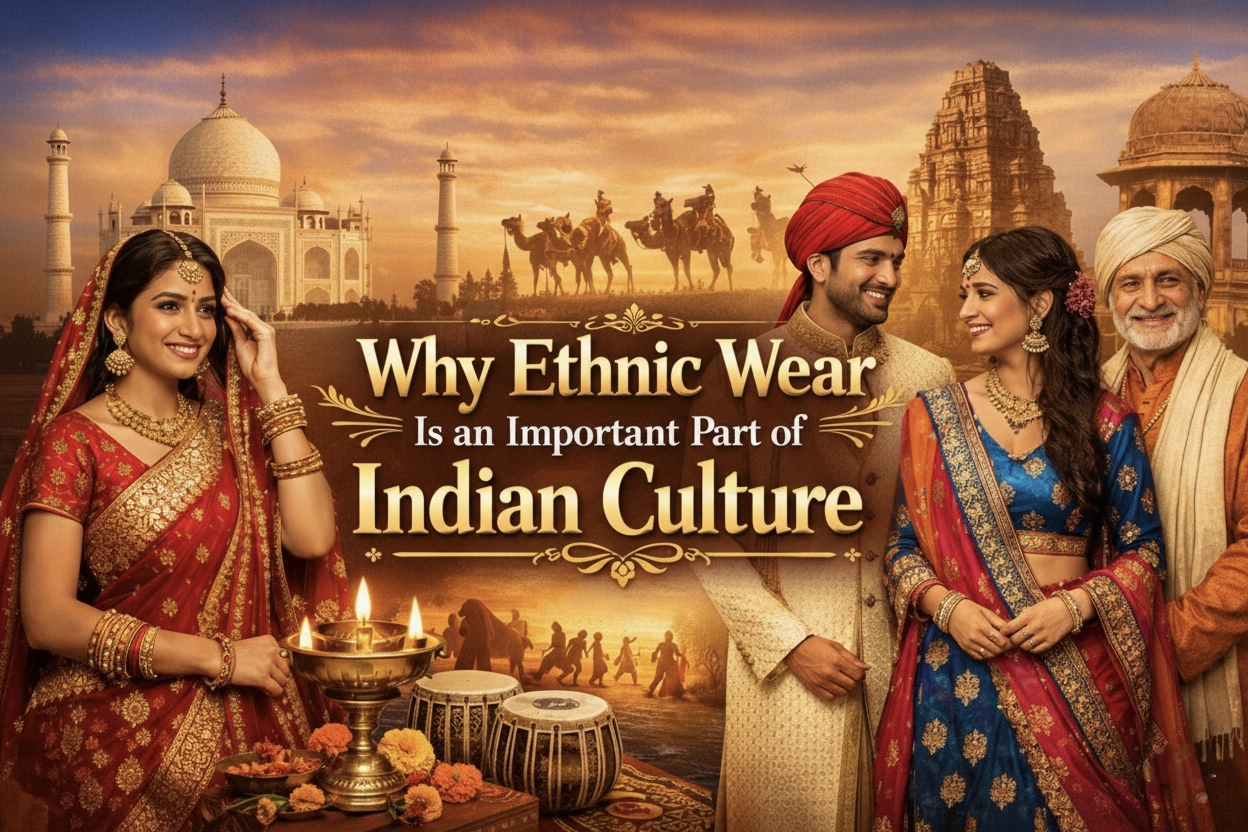
Ethnic wear happens to be a significant player in Indian culture long famed for its outstanding richness, and diversity. In these situations, people use their ethnicity as identification, used to categorize people and additionally help people to recognize differences in the multitude of cultures. Furthermore, clothing is a non-linguistic method of communication that people use to show their identity, express their diversity, and represent their village and country. People who use the traditional dress styles can be identified easily as traditional villages are diverse and wear their traditional dress styles. These long-standing practices are what compose the valuable fabric of life, and every new generation conveys them as a result of purposive teaching from one another, in particular family members.
1. Representation of Cultural Diversity
India is a country with a wonderful geographical diversity home to a myriad of cultural, linguistic, and traditional backgrounds. Talking about every single district in South India, one can notice the diversity in Indian ethnic wear styles, for example, in the south the saree has a polished individual appearance while in the north many women might wear a lehenga choli due to all the bright colors that are presented. Still, the diversity of the country is a reflection of the many different communities living together in peace, who have all contributed to making the country a cosmo-multicultural garden.
2. Preservation of Tradition
Traditional outfits often serve as the reminder of the starting point of the knowledge and skill of the ancient craft that has been loved by people since ancient times. Moreover, the traditional artistry of the fabric on which embroidery was done by hand, and the pointillist-like designs that were covered from the cloth, are clear signs of the talent, patience, and experience of Indian craftsmen. These classic outfits are not merely clothes of a tradition but they are the exponents of the past that have made its way even in the present and will continue to do so in the future.
3. Cultural Identity and Pride
Adorning cultural attire is an effective way for people to display their cultural identity and pride. When people come together at times such as festivals or on special days, wearing their traditional outfits is respected by everyone and results in their gathering becoming a mutual act through which they express their Brazilian identicalities. This festive aspect of ethnic wear is something that binds the people of the community together resulting in the development of a feeling of belonging and being proud of being Indian as an end result.
4. Influence on Global Fashion
The Indian traditional wear has not only conquered the Indian market, but it has also taken over the world fashion industry too. Designers from the world over are fascinated by India’s vibrant colors, elaborate patterns, and distinctive silhouettes in Indian ethnic wear. This full-scale interaction from across the world has facilitated a mixture of innovative ideas that have produced a worldwide admiration of India’s cultural aesthetics.
5. Economic Significance
The sari industry empowers the economy of India. The demand for artisans, weavers, and small-scale industries is thus high and this creates jobs for millions. The use of things such as Wholesale kurtis has been instrumental in strengthening India’s textile industry. It has thus been an effective way of not only enhancing the aesthetic appeal of traditional clothing but also the disposable income of those that do the traditional dressing.
6. Expression of Art and Craft
Indian ethnic clothing catalog is a testimony highlighting the country’s artistic and craftsmanship heritage. From hand-painted fabrics to the most complex beadwork, each piece of ethnic outfit reflects three parts artistry and one part skill. Indian artisans are provided with an environment to express their ideas, and they are also taught the conventional techniques, which have sustained them for centuries.
7. Special Occasions and Festivals
In India, ethnic wear is considered indispensable for special days and festivals. Be it a wedding, a religious function, or a national function, people’s unique dressing acts as a glint of grace and an identity-identifying garb. These clothes carry deep symbolical meanings and are often worn for worship and to draw prosperity on such days.
8. Versatility and Adaptability
Ethnic wear grants the flexibility to wear them at many different events. Whether or not they are dressed differently, Indian women mix traditional elements with keen adornment to give their looks a more eclectic and stylish edge. Thus, Indian wear is thus the only wear that remains a cool vibe even with generations.
9. Support for Local Artisans
Buying ethnic clothes from local craftsmen and weavers has a significant impact on the preservation of traditional skills. Encouraging the business of traditional crafts like Sarees wholesale, supports the artisans in getting a fair wage for their craftsmanship, providing the opportunity for them to allow their skills to flourish and carry on traditional activities that have been part of their heritage for so long.
10. Educational Value
Ethnic attire also turns out to be a learning tool for today’s generation, thus it helps to pass on the cultural heritage of India to the younger generation. Schools and other places of learning frequently include ethnic wear in their syllabuses which educates students about the significance of various attires, fabrics, and patterns making sure Indian culture is not lost in future generations. Consequently, a feeling of love and respect to the Indian community among the wild population has been promoted.
11. Symbol of Unity
Even though India is home to countless cultures and traditions, ethnic wear stands as a binding force. It is a fashion an individual carries which in its turn becomes the factor that unites people from different ethnic communities creating peace and a feeling of unity. Clothing olden by traditional day that shows unity closer.
In summary, ethnic wear, apart from being just a piece of clothing, is also a very strong cultural symbol that embodies the essence of the rich cultural heritage of India. From the patterns to the colors, every piece paints the picture of history, tradition, and the scales that make up Indian society. These are elements that contribute to the acceptance and celebration of traditions that are deeply entrenched in the society, yet which are also conducive to progress and thus spot India in a class of its own when it comes to culture.
12. Sustainability Factor
In today’s era of fast fashion, ethnic wear is distinguished by its sustainability. Traditional attire is commonly made from natural fibers and eco-friendly methods are used to craft them. This is to reduce the environmental impact as well as to appeal to ethical fashion by encouraging buyers to invest in quality pieces that have a longer lifespan and can be reused to practice sustainable living. This not only reduces the environmental impact but also strengthens. The second purpose is to design ethical fashion by persuading buyers to buy better quality garments. Thereby, the purchase of those clothes not only implements environmental friendliness but also assures that the consumer is spending tastefully and in this way leads to a more sustainable lifestyle.
13. Unique Fashion Statements
Indian ethnic wear is a platform for showing up individually in fashion. With Indian ethnic wear every piece is different, has subtle designs, bright colors, and rare patterns that are not found in Western outfits. Each item is created to be distinct with intricate details, liveliness, and a variety of colors that cannot be usually found in Western wear. It is nearly unfair to ask a person who has a clinic sari, a formal sherwani, or a stylish salwar kameez because these outfits give them the entire freedom in embodying their individual perspective as well as appreciating the cultural heritage they come from.
14. Legacy and Heritage
Clothes are often an inheritance and are carried along from our lineage and where they come from, the stories are still there. Thus, traditional clothing is the common charger which still connects the old stories. If we can see an heirloom that is from grandma like a particular silk saree or a woven shawl, we can feel the passing and connection of generations, the link between the past and the future. They are also sort of records which hold the whole structure of the family and also keep the connection between the two, family and tradition.
When I think of Indian ethnic wear I envision a versatile set of lifestyle, customs, and identity layers living in sync with the geography. This type of dress not only serves the country’s historical background, arts, and ethnicity but highlights the multicultural diversity of India as well. Regardless of the day or the occasion, ethnic wear remains a strong and indispensable part of the Indian community and brings together people around the world as a symbol of cultural pride and unity.
In the contemporary world, the trends turn towards the development of sustainability driven attire and these tend to get preferred as the natural fibers and the traditional fabric weaving techniques used in ethnic wear offer an eco-friendly and rightful production process. It is through this approach that the continuity and modernity of the traditional Indian textiles are assured and, as a result, a consumer with an environmental morality will get more interested.
Ethnic wear in India is a natural state of creative evolution where new generations keep collecting their symbols around it, but its essence remains static. The fusion of traditional and modern styles of ethnic wear enables them to offer themselves as a true embodiment of unity in diversity. This example of cultural richness, through its unique beauty and deep meaning, is still alive and is able to impress and attract audiences around the world. In such societies, ethnic wear is not simply a form of dressing; rather, it is a way of celebrating the traditions and the spirituality of the people.