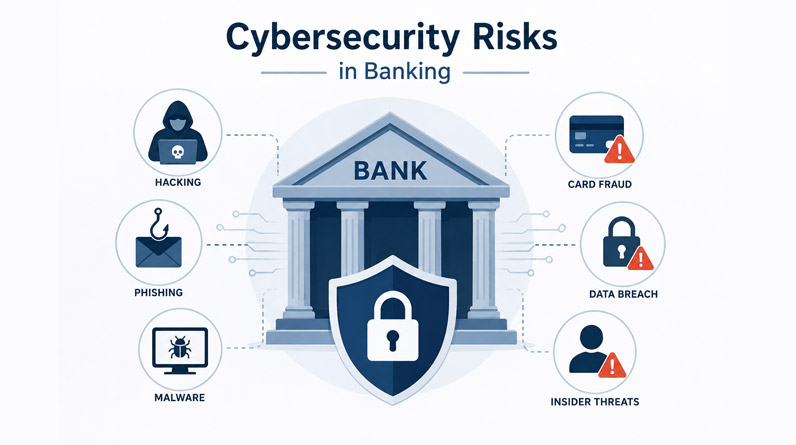
Cybersecurity has become a major concern for the banking industry as digital transactions, AI-based services, cloud-driven banking and expanding open banking platforms. Financial institutions face cyberthreats like ransomware attacks, data breaches, phishing scams, AI-based cybercrime, insider threats, which causes financial loss, operational disruptions and regulatory penalties. As cybersecurity becomes a strategic business risk, organisations are seeking FRM course professionals who can identify, evaluate and combat tech-related financial risks.
FRM professionals are trained to assess operational, market, technology and credit risks while developing robust risk mitigation strategies. As cybersecurity becomes an essential component of enterprise risk management, knowledge gained through FRM full form (Financial Risk Management) program helps experts to determine cyber risks frameworks, risk assessment techniques and regulatory compliance and business continuity planning.
Why Professionals Must Master FRM Course Skills For Cybersecurity Risks In Banking?
1. Cyber Risk Has Become a Core Financial Risk
Nowadays, cybersecurity is not merely a technical issue of the bank! In 2026, hackers will be able to disrupt the process of payments, bring the institution down, steal the data of their clients, and inflict significant damage to the bank. With the development of online banking services, artificial intelligence solutions in finance, and cloud technologies, financial organizations have to deal with cybersecurity risks. Risk professionals must determine how cyber incidents can influence market confidence, operational resilience, liquidity and regulatory compliance.
FRM full form (Financial Risk Management) program equips professionals with frameworks to identify, evaluate and manage enterprise-wide risks like technology-related and operational risks. FRM-certified professionals learn how cyber risks fit into an organisation’s risk management strategy, allowing them to support governance, enhance risk reporting and assist banks prepare for the evolving digital threats.
2. Operational Risk Management Is More Critical Than Ever
Cyberattacks result in operational failures like service disruptions, fraudulent transactions, system downtime and data breaches. Banks have to assess the above-mentioned risks and formulate ways of reducing operational loss without disruption of their operations. With an increase in digital transactions, operational resilience has become a regulatory expectation of all international financial firms.
In FRM course, one can learn about different approaches to managing operational risks such as risk identification, loss events evaluation, scenario analysis and internal controls evaluation. Such skills enable professionals to predict cyber-related operational risks and suggest appropriate solutions.
3. Regulatory Compliance Around Cybersecurity Is Expanding
Strict measures related to cybersecurity and operational resilience are still being imposed by financial regulators across the world. Banks should implement better governance practices, have an incident response plan, regularly perform risk assessment, and ensure that third party cybersecurity controls comply with the regulations.
People who want to take the FRM course can get knowledge regarding the principles of governance and risk management framework. Such information will help them cooperate with compliance staff, internal auditors, and cybersecurity professionals to ensure that the financial organizations follow all the regulations.
4. Third-Party and Vendor Risks Continue to Increase
Banking organizations depend on cloud computing, payment processing, fintech companies, and external technology providers. Although such collaboration brings greater efficiencies and innovations, it also brings new threats to cybersecurity. A breach within a third-party service provider can impact a bank’s operations, regulatory standing and customer trust.
FRM certification teaches professionals how to assess interconnected risk across business ecosystems. They learn vendor risk assessment techniques, control evaluation techniques and concentration risk analysis that helps companies to identify weaknesses in third-party relationships and implement stronger risk management practices.
5. Cyber Incidents Require Strong Scenario Analysis and Stress Testing
Modern banks cannot rely solely on historical cyber incidents to predict future risks! It is vital that they perform scenario analysis and stress testing to estimate the effect of any massive ransomware attack, technology breakdown, or payment system disruption on capital, liquidity, earnings, and reputation.
Scenario analysis and stress testing forms a vital part of FRM course syllabus. Professionals develop expertise in risk scenario-building, impact assessments on finances, assessment of recovery capacity, and support for business continuity management as these skills are essential given the unpredictability and significant impact that cyber risks can have on financial institutions.
6. Data-Driven Risk Decision-Making Is Becoming Essential
Banks generate enormous volumes of cybersecurity, operational, transaction and customer data each day. Analysis of such information would reveal any abnormal behaviors, any vulnerabilities that may have occurred, or even any patterns of fraud or any possible risks before they become big problems. Such a data-driven risk management process facilitates decision-making processes.
A FRM full form (Financial Risk Management) program enhances the ability of analytical thinking through learning how to measure risks quantitatively, statistical analysis, and risk measurement techniques. This makes it easier to analyze any financial risks that may arise because of cybersecurity.
Conclusion
In view of ever-evolving cybersecurity challenges, banks require specialists who would be able to detect, analyze and mitigate technology-based financial risks. The FRM course provides future risk managers with tools and knowledge necessary to cope with such tasks.
Are you ready to build a future-proof career in risk management? Contact Zell Education experts and explore how expert-led FRM programs can help develop practical skills needed to succeed in the rapidly changing financial industry.
FAQs
1. In what ways can the FRM program help in cybersecurity risk management?
FRM certification gives professionals the skills necessary to handle cybersecurity risks in terms of identifying, assessing, mitigating, and governing them.
2. Which cyber risks do banks encounter?
Banks are exposed to the following types of cyber risks: ransomware attacks, phishing, insider threat, data breach, and vendor risk.
3. Are FRM professionals eligible to handle cybersecurity-related risk management positions?
Yes, FRM professionals are eligible to work in technology, enterprise risk management, and operations positions.