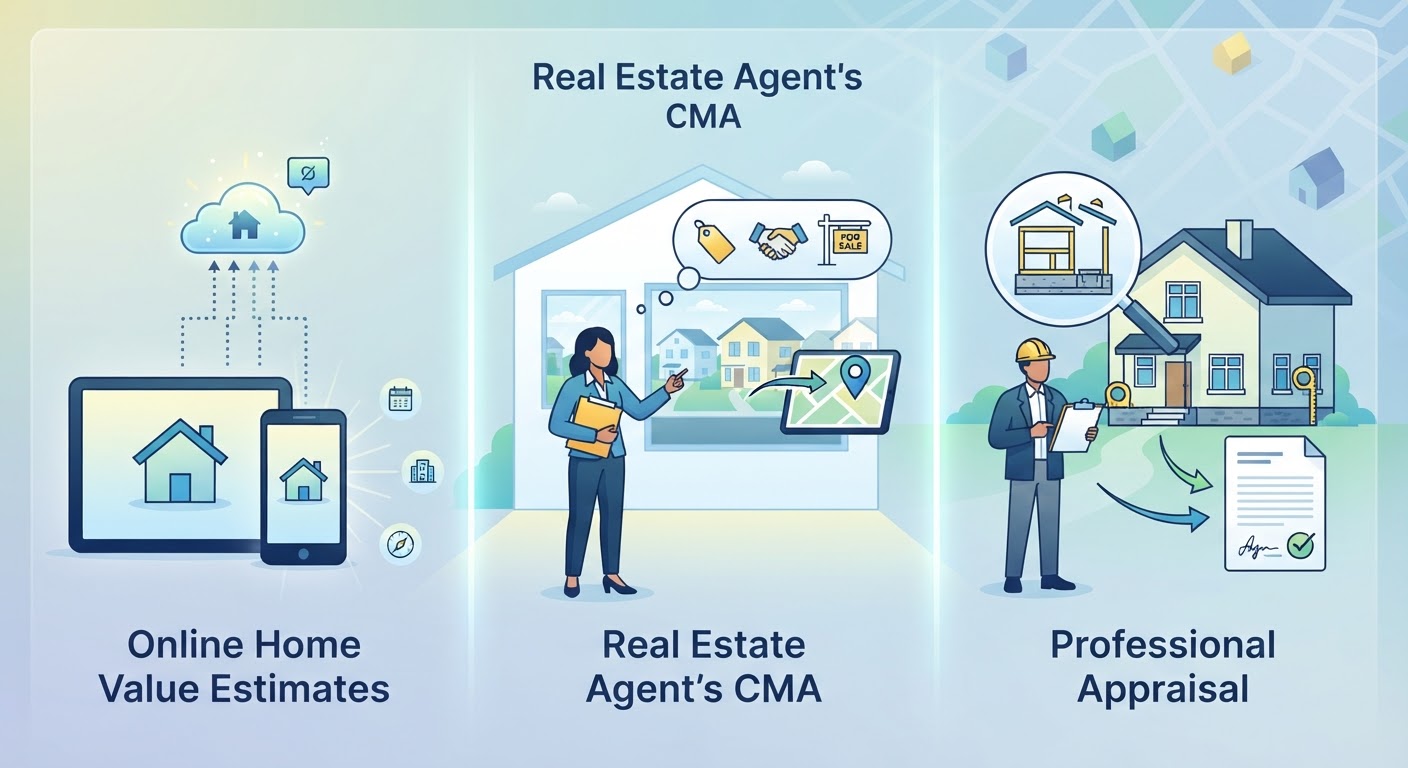
It is common to enter the same address on several real estate websites and get several different home values. That does not necessarily mean a tool is wrong. Each estimate can rely on different public records, listing information, comparable sales, update schedules, and assumptions. Before making a major decision, it helps to understand the most accurate way to estimate your home value for your particular situation.
A quick online estimate, a real estate agent’s market analysis, and a professional appraisal can all be useful, but they answer different questions. The right option depends on whether you are casually tracking equity, preparing to sell, refinancing, planning renovations, or handling a legal or financial matter.
Key Takeaways
- Online home value estimates are helpful starting points, not substitutes for appraisals.
- Automated valuation models depend on available property and market data.
- A comparative market analysis can provide practical guidance when setting a listing price.
- An appraisal may be necessary for lending, estate, divorce, tax, or legal purposes.
- The best valuation method is the one that matches the decision being made.
Why Home Value Numbers Can Vary
Home values are opinions based on evidence, not permanent labels attached to a property. An online estimate may emphasize recent sales and public records, while another model may place greater weight on listing data, prior transactions, neighborhood patterns, or property characteristics. Even small differences in lot size, square footage, condition, or the sales selected for comparison can change the result.
In plain language, an online estimate is a quick value generated from available data. An automated valuation model, often called an AVM, uses software to analyze large amounts of real estate information. A comparative market analysis, or CMA, is a local pricing opinion often prepared by an agent. An appraisal is a formal opinion of value prepared for a defined purpose by a qualified appraiser.
How AI and Automated Valuation Models Work
AI-enabled tools and AVMs can review information such as location, recorded square footage, age, prior sales, tax records, listing details, and nearby transactions. Their speed comes from analyzing existing information at scale rather than sending someone to inspect each property individually.
That efficiency also creates limits. A model may not fully capture a remodeled kitchen, a newly finished basement, deferred maintenance, a premium view, a noisy roadway, an unusual layout, or an addition that does not appear in public records. For lending, valuation options can range from model-based approaches to desktop, hybrid, and traditional appraisals, depending on the transaction and the available property data, as outlined in current property valuation guidance.
What an Online Home Estimate Can and Cannot Tell You
An online estimate can be a useful first look at potential equity, broad neighborhood trends, and whether it may be time to speak with a local professional. It can also help homeowners compare several estimates and identify property details that may be missing or outdated.
However, a single online number should not stand alone when the decision has financial or legal consequences. More research is usually appropriate when setting a price for an unusual home, estimating the impact of major improvements, applying for a mortgage, dividing property in a divorce, settling an estate, or challenging a tax assessment.
Online Estimates Compared With Comparative Market Analyses
A CMA adds local judgment to the pricing process. An agent may review recent comparable sales, active competition, pending listings, upgrades, condition, buyer demand, and details that may not be visible in a database. This makes a CMA especially useful when preparing a home for sale.
A CMA is still not the same as a formal appraisal. It is generally designed to help a homeowner understand a likely listing or marketing range, while an appraisal is completed for a specific intended use and effective date.
The comparison below shows how the main valuation methods are typically used.
| Method | Best For | Key Strength | Main Limitation |
| Online estimate | Early research | Fast starting point | May miss condition and upgrades |
| CMA | Preparing to sell | Local market perspective | Not a formal appraisal |
| Appraisal | Lending or high-stakes decisions | Defined scope and written support | Requires more time and expense |
When a Professional Appraisal Makes More Sense
An appraisal is designed for a specific assignment. The appraiser analyzes the property, relevant market evidence, and comparable sales, then provides a supported opinion of value. The assignment may involve an in-person inspection or another permitted scope of work, depending on the purpose and requirements.
Professional standards matter because the intended use matters. The frequently asked questions on appraisal standards explain that appraisal reporting is governed by professional requirements rather than simply by a preferred form or template.
Five Steps Before Ordering an Appraisal
- Ask the lender, attorney, or advisor whether an appraisal is required.
- Confirm why the valuation is needed.
- Identify the effective date of value.
- Gather permits, repair records, and improvement details.
- Choose an appraiser familiar with the local market and property type.
Why Data Quality Matters More Than a Confident Number
A precise-looking estimate can still be based on incomplete information. This is especially important when there are few comparable sales, the market is changing quickly, or the home has features that are difficult to match with nearby properties. A narrow number may look authoritative even when the underlying evidence deserves a closer review.
Focus on the information behind the result. Check the sale dates, locations, sizes, condition, and similarities of the homes used for comparison. A good valuation discussion should allow for uncertainty rather than treating every estimate as a guaranteed sale price.
A Practical Three-Step Home Value Check
- Collect several starting points. Review more than one online estimate and note the date associated with each one.
- Check comparable sales. Look for recently sold homes with similar location, size, age, lot, condition, and features.
- Adjust for missing details. Consider upgrades, repairs, layout differences, lot advantages, and nearby nuisances.
For example, three estimates may cluster in a similar range, but a new roof and finished basement could affect buyer interest. The likely value may move in the opposite direction if the home needs substantial repairs or sits beside a busy road.
Questions to Ask Before Trusting a Valuation
- How recent are the comparable sales?
- Are the comparable homes genuinely similar?
- Does the estimate reflect the home’s present condition?
- Have renovations been recorded accurately?
- Is the estimate being used for pricing, lending, tax, or legal purposes?
- Would a local professional notice factors the model cannot see?
Common Mistakes to Avoid
Do not automatically choose the highest estimate, assume an online value is an appraisal, ignore repair costs, or compare homes from distinctly different neighborhoods. It is also risky to rely heavily on older sales when local inventory, buyer demand, or financing conditions have changed.
A range is often more useful than a single figure. Real estate outcomes depend on timing, condition, exposure to buyers, financing, negotiation, and the home’s specific appeal. A realistic range supports better planning without creating false certainty.
How to Choose the Right Valuation Method
- Curiosity or rough planning: Start with online estimates.
- Preparing to sell: Review comparables and request a local CMA.
- Buying or refinancing: Ask the lender which valuation method is acceptable.
- Divorce, estate, or legal matters: Consider a formal appraisal.
- Renovation planning: Compare project costs with local demand for similar updated homes.
Conclusion
No single number can answer every home value question. Online estimates offer a useful first look, a CMA can help shape a selling strategy, and a professional appraisal may be the better choice when the stakes are high. Choose the valuation method that fits the decision, then examine the data and assumptions behind the result.