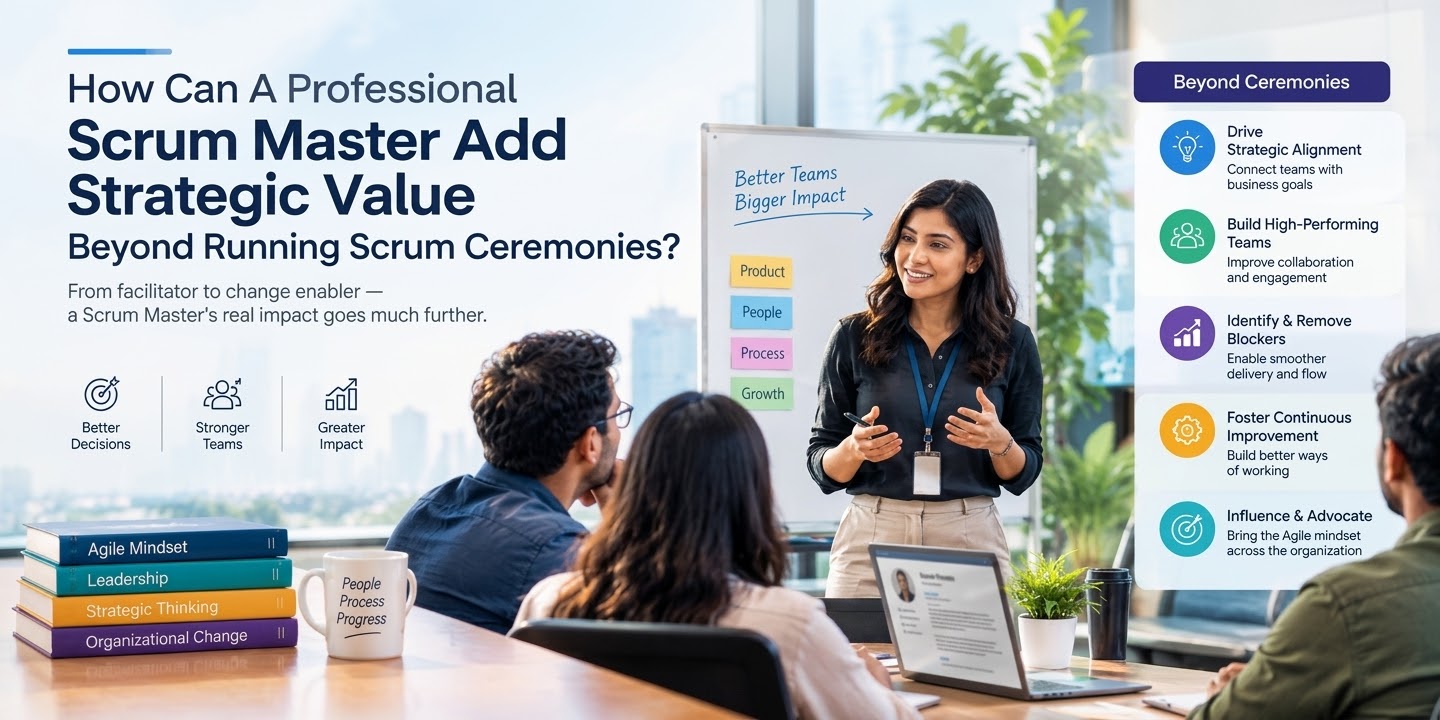
A Scrum Master adds strategic value by focusing less on facilitating meetings and more on contributing to outcomes: getting rid of organizational impediments, coaching leaders, making sure the team is aligned with the strategic direction, and measuring progress in terms of value delivered, not work done. Ceremonies are just a means to an end, but the end often resides in the realm of strategy. If you are interested in learning to effect positive change in your workplace and acquire the experience and qualifications to do that, join the SSM Certification Program with Simpliaxis and turn your facilitation skills into strategic value.
What Does a Scrum Master Do Besides Running Meetings?
Sprint planning, daily stand-ups, reviews, and retrospectives are essential activities, but they comprise only a small part of a Scrum Master’s job. They serve one primary purpose: to enable the team to operate effectively.
- Ensuring the team can consistently create value.
- Delivering high-quality outcomes by removing impediments within their sphere of influence.
- Coaching the Product Owner, developers, and leadership to embrace an agile mindset.
- Encouraging the team to improve constantly based on evidence.
In other words, the Scrum Master has to be a servant leader, making the team more effective. Facilitation is only one lever they can pull, and not the most critical one.
Why Are Strategic Contributions Becoming More Important for Scrum Masters?
Organizations are reevaluating roles that have been considered system-sustaining for decades. They seek to optimize processes and reduce the number of people needed to perform them. Scrum Masters whose sole purpose is to host meetings and serve as communication hubs can expect to see their roles automated or combined with that of other specialists. Scrum Masters with strategic minds, however, can demonstrate the value they bring to the table.
Executives do not care how the team prepares for the sprint or what they discussed during the retrospective. They are interested in whether the work the team does contributes to achieving strategic goals. And a Scrum Master can influence that directly.
How Can a Scrum Master Make the Connection Between Their Work and the Team’s Objectives?
Developers and testers are in an excellent position to execute the work but may not be aware of the company’s objectives. Sometimes, the connection between their work and the company’s strategy is not apparent, and the team may struggle to deliver relevant outcomes. A Scrum Master can help in the following ways:
Ensure a shared understanding of the product vision: Coordinate with the Product Owner to make sure that every action contributes to a well-defined goal.
Create visibility into outcomes: Use the sprint review to highlight what the business achieved rather than simply reporting what the team accomplished.
Evaluate the priority of items: Question the value of each item on the list before it goes through the sprint planning.
Communicate across levels of the organization, Convey the business context to developers: explain why certain features are needed. Likewise, ensure that developers’ concerns are heard at the business level.
By making everyone aware of the bigger picture, a Scrum Master can inspire the team to self-manage, which is always preferable to relying on the control the Scrum Master exercises.
How Can a Scrum Master Take Action to Eliminate Impediments?
Organizational impediments are a category of impediments that the Scrum Master can address, even though they are not directly related to the team’s work. There are several types of organizational impediments: approval processes, funding models, dependencies, and policies. A Scrum Master can tackle these issues by researching and analyzing them, bringing relevant facts to the attention of those in a position to address them, and influencing their future by demonstrating how eliminating them can benefit the team and the company. The latter is always the most effective option, and a Scrum Master should invest time in researching the issue and presenting it to leaders.
Organizations tend to give up on Scrum Masters because they have little authority. They cannot force their colleagues to change established behaviors; therefore, a Scrum Master has to rely on influence. And once they provide sufficient justification for change, it becomes much easier to convince someone to comply.
What Metrics Should a Scrum Master Use to Demonstrate Strategic Value?
It is difficult to quantify the intangible benefits a Scrum Master brings to the table. Fortunately, several readily available, easy-to-understand metrics can show that the team is on the right track.
Examples include throughput, cycle time, and lead time.
A Scrum Master also wants to demonstrate that progress is consistent, so showing trends in delivery lead time or the percentage of predicted versus actual work done can be helpful. In addition, metrics that reflect quality improvements, such as the number of escaped defects, or increased customer satisfaction can be used. And finally, a Scrum Master can show that the teams are growing more and more capable of self-management and delivering quality results on time.
How Do Coaching Skills and Leadership Engagement Affect a Scrum Master’s Strategic Contribution?
A Scrum Master who coaches the team and engages with leaders can have a more significant impact on the product and the company. Many projects fail because leaders do not support an agile approach, but a Scrum Master can influence them directly. If executives continue to dictate decisions, believe that the fixed-price, fixed-scope model is viable, or hold personal opinions about team members, they hurt the chances of the project’s success. A Scrum Master can guide them through the transformation and encourage change by example. They can also invest effort in coaching their managers to become more agile themselves, influencing outcomes at a larger scale.
In many ways, an ability to coach is the hallmark of a great Scrum Master. It allows transforming one’s sphere of influence into actual improvements and taking the Scrum Master’s work to a higher level.
Fortunately, it is a skill that can be learned and improved with the proper training. Simpliaxis has the instructor-led Scrum Master and Project Management courses to help you improve your coaching skills and advance your career.
How Can Certification Help a Scrum Master Become More Strategic?
A Scrum Master can gain the knowledge and the confidence to act more strategically by receiving a certification. Most importantly, it provides the vocabulary and the conceptual framework that the Scrum Master can use to communicate their contributions and influence the executives. Another advantage of a Scrum Master certification is an understanding of the reasons behind the Scrum rules rather than blindly following them. And that, in turn, allows a Scrum Master to use Scrum principles in novel ways to achieve better results.
Depending on one’s needs, there are several options for obtaining the Scrum Master certification. For someone just getting started, the SSM Certification Program offers an entry-level look into the Scrum Master role and prepares them for the next steps. When the time comes to expand one’s horizons, more advanced options present themselves. Some, such as SASM Certification Training, are designed specifically for people working in an enterprise setting in an environment with multiple Scrum teams.
What Circumstances Would Someone Need Advanced Scrum Master Certification Skills?
As the company grows, the product usually requires more work than a single Scrum team can handle. Multiple teams need to collaborate on the same product, and their combined efforts need to be reconciled and coordinated. This state of affairs requires a Scrum Master to have additional skills, including aligning teams on a larger scale and facilitating larger meetings. It also implies that it is useful to invest time in obtaining additional expertise. For this purpose, one may choose the SASM Certification Training.
Simpliaxis is here to help you navigate your Scrum Master career and advise you on what to do next.
What Can a Scrum Master Do This Quarter to Become More Strategic?
A Scrum Master can begin to act more strategically by taking small steps and learning new behaviors. Here is a short list of ideas:
- After sprint review, instead of discussing what the team did, talk about what that contributes to the company’s strategic goals.
- Keep an impediment log and share it with interested parties.
- Regularly, present a trend analysis of a relevant metric. The metric should reflect how the team is doing in a way that contributes to the strategic goals, and the analysis should be simple and understandable.
- Have a conversation with the Product Owner about the importance of value. Make deciding what to do next a collaborative effort.
- Invest in learning to gain new behaviors and new skills.
Final Thoughts
The Scrum Master’s role is changing, and those who will thrive in the future are the ones who influence their companies’ strategic direction. By learning to connect the work of the team to the value delivered to the customer, eliminate impediments, and coach leaders, a Scrum Master can maximize their sphere of influence and advance their career.
If you are ready to take this step and become an influential Scrum Master, join the SSM Certification Program with Simpliaxis and start your journey today!