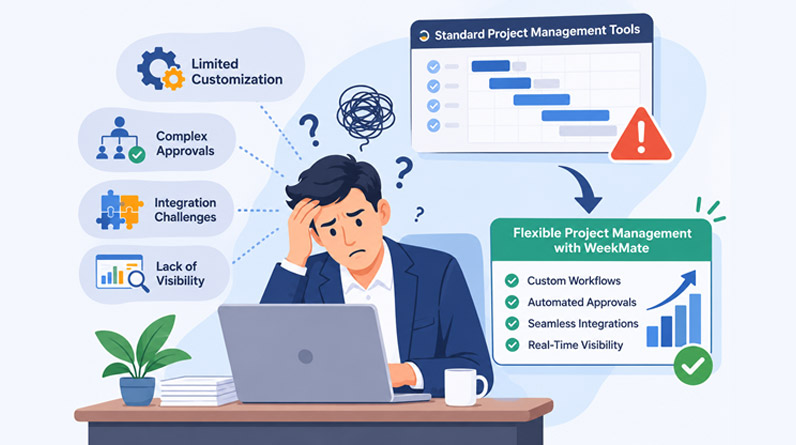
Companies usually begin by using standard project management tools to help plan tasks and deadlines, as well as facilitate cooperation among team members. However, as the company grows, the process of managing several departments, approval processes, customers’ demands, and interrelated projects become increasingly difficult. Standard tools do not offer enough flexibility for companies to effectively manage all these processes.
Although project management applications help teams cope with routine tasks, they may find it hard to work with complex business processes, customization, and organizational needs. In this case, companies need flexible tools, such as custom project management software, that can be adjusted to fit companies’ business processes instead of making employees conform to them.
This article considers why standard project management tools cannot cope with complex business processes, what difficulties businesses face, and how flexible project management tools can help improve the efficiency of operations.
1. Limited Customization for Different Business Workflows
Every business will have distinct processes in its operations. There could be approvals of production, inventory coordination, and quality assurance in case of a manufacturing firm, while marketing campaigns, content approvals, and client interaction in case of marketing firm.
Predefined workflow and task management tools that come standard in most project management systems are sufficient to support project coordination. However, they might not fit specialized needs of businesses.
For instance, in case a business is overseeing multiple departments, there could be distinct task allocation criteria, approval hierarchies, reporting structures, and phases for each project. In such cases, teams usually fall back to spreadsheets and email communications.
How this affects businesses:
- Teams struggle to adapt workflows to their requirements.
- Employees follow unnecessary steps to complete tasks.
- Department-specific processes become difficult to manage.
- Businesses rely on additional tools to fill functionality gaps.
A better solution: Companies should look into more adaptable project management options that would enable them to adjust their task structure, workflow, permissions, and approval process according to their needs.
2. Difficulty Managing Complex Approval Processes
Approvals process is one of the key aspects of the company’s operations. Approvals can be needed for any business processes such as budget approvals, purchase requests, project approval, and other employee-related requests.
While standard project management software often has some approval features, handling complicated approval processes becomes problematic.
For instance, purchasing requests should be approved by the department manager, finance department, and management. In case the software does not allow to handle conditional approvals and multiple approval layers, employees will have to communicate via email.
It leads to delays and problems with tracking of the approval process.
Common challenges include:
- Multiple approval levels are difficult to configure.
- Approval responsibilities are not clearly defined.
- Manual follow-ups delay project execution.
- Tracking pending and completed approvals becomes complicated.
Companies require workflow automation features that facilitate multiple approval levels, automatic alerts, and role definition.
3. Limited Integration with Existing Business Systems
Businesses do not solely rely on one software package only. They have other software for managing human resources, payroll, customer relationship, accounting, inventories, communication, and project management.
If the typical project management software has limited capabilities of integration, then data will be stored in various software packages.
For instance, the sales team handles the needs of the customers using the CRM software, while the project team keeps track of the delivery using a separate software package.
This can result in:
- Duplicate data entry.
- Inconsistent business information.
- Communication gaps between departments.
- Delayed project updates.
- Reduced operational visibility.
A connected software ecosystem facilitates businesses to share information between various systems and streamline their processes. Integration plays an extremely important role for organizations that run various business processes.
4. Poor Visibility Across Multiple Projects and Departments
Project management in one project is not that complicated. But managing multiple projects in different departments demands more visibility and proper utilization of resources.
Regular project management applications can offer some level of dashboards and task reports, but they may lack necessary insight into running multiple interrelated projects.
For example, a project manager overseeing multiple teams needs to understand:
- Which projects are progressing as planned?
- Which tasks are delayed or blocked?
- How are resources distributed across departments?
- Which teams have pending responsibilities?
- Are project deadlines and business goals being achieved?
In the absence of centralized visibility, managers may be required to gather updates from different teams manually. This will lead to slower decision-making and increased chances of missing deadlines.
A scalable project management tool should have features like centralized dashboards, real-time progress tracking, workload visibility, and report generation for efficient monitoring of business processes.
5. Inflexible Task Assignment and Resource Management
Resource management tends to be more complicated when organizations grow. This is because staff members might be involved in various projects, have several duties, and work in collaboration with various department teams.
Project management software might offer simple task assignment functions but lack advanced resource allocation functionalities.
For instance, a software developing organization might assign developers, designers, testers, and project managers to various projects. Without adequate tracking of their workload, some staff members can be overburdened, while others will still have unused capacity.
This can lead to:
- Uneven workload distribution.
- Delayed task completion.
- Conflicts in employee responsibilities.
- Difficulty managing cross-functional teams.
- Reduced team productivity.
Businesses need project management tools that support flexible task allocation, workload monitoring, role-based responsibilities, and resource planning.
6. Manual Processes Increase Administrative Work
Most project management techniques used as organizational tools can help manage different tasks but cannot automate all repetitive actions that take place within the scope of business operations.
Manual alerts, task status update, follow-ups on pending actions, as well as communication about project changes, might become necessary.
The more there are of these activities, the more time workers devote to administrative duties and less time is dedicated to their key project duties.
For example, when a particular action shifts to the next step, it might be necessary to inform the next person responsible for this action manually.
Project workflow automation can help reduce these repetitive activities through:
- Automated task notifications.
- Deadline reminders.
- Automatic task status updates.
- Workflow-based task assignments.
- Recurring task management.
- Automated approval notifications.
By reducing manual coordination, businesses can improve workflow consistency and help employees focus on productive activities.
7. Difficulty Scaling with Changing Business Requirements
Project management solutions which work well in a small team can become ineffective with an increase in the size of the organization.
The business grows in size and its needs also change; it can create new departments, operate in different locations, have large teams, and take up complex projects.
The standard project management solutions may lack the flexibility needed for such growth.
An example is the need for basic task tracking at the early stages of the growth of the organization, followed by needs for multiple approval levels, departmental dashboards, detailed reporting, integration capabilities, and workflow automation.
If the current solution does not allow for satisfying these needs, the business can find itself forced to purchase additional software products or move to a completely different system.
A scalable solution must meet changing business needs without forcing businesses to rework all existing processes.
8. Limited Reporting and Business Insights
Effective reporting enables managers to gain an insight into the performance of their projects, detect bottlenecks, and make appropriate business decisions.
Nevertheless, conventional project management tools may offer preconfigured reports that cannot satisfy all needs of any particular business.
Different departments need different performance indicators. For example:
- Project managers need task completion rates and project timelines.
- Finance teams need budget utilization and project costs.
- Department managers need employee workload and productivity reports.
- Business owners need an overall view of project performance.
In situations where reporting abilities are limited, the manager may have to aggregate data from various sources in order to evaluate business performance.
A dashboard and reporting tool may help businesses measure certain metrics, keep track of projects and identify weak points.
9. Poor Adaptability to Industry-Specific Requirements
Different types of industries have different types of procedures, compliances, and structures. A generic project management tool cannot meet all requirements of a particular industry.
For example:
| Industry | Specific project management requirements |
| Manufacturing | Production coordination, quality checks, and operational approvals |
| Construction | Project scheduling, site coordination, and resource tracking |
| IT and Software | Sprint planning, bug tracking, and development workflows |
| Marketing | Campaign planning, content approvals, and client coordination |
| Professional Services | Client projects, team allocation, and delivery tracking |
In cases where the software does not support these industry requirements, there may be a necessity for the company to resort to manual approaches or other software.
Project management software that is flexible enables organizations to customize their workflow, tasks, and reporting based on the nature of the industry and business process.
How Custom Project Management Software Solves These Challenges
Custom project management software can serve as an option for companies if standard project management techniques fail to meet their needs.
Unlike pre-set systems, a custom solution can be tailor-made according to the current processes and goals of the company.
Here are some ways it can help:
1. Customized Workflows
Businesses can create workflows based on their internal processes, including task stages, responsibilities, approval levels, and department-specific requirements.
2. Automated Business Processes
Automation helps reduce repetitive administrative activities through automatic notifications, task assignments, reminders, and approval workflows.
3. Centralized Project Management
Teams can manage projects, tasks, deadlines, and responsibilities through a centralized platform instead of switching between multiple applications.
4. Flexible Integrations
Integration with existing business applications helps maintain consistent information and improves coordination between departments.
5. Custom Dashboards and Reports
Businesses can monitor project progress, team performance, workload distribution, and operational activities through reports relevant to their requirements.
6. Better Scalability
Flexible solutions can accommodate new teams, departments, workflows, and business requirements as organizations expand.
How WeekMate TaskHub Supports Flexible Project Management
WeekMate realizes that all businesses have unique project management needs. Task and deadline management is just one piece of it since businesses need to be flexible, visible, and have control over their workflows.
WeekMate TaskHub is an artificial intelligence (AI) driven project management tool that is meant to assist businesses in organizing their projects, managing tasks, coordinating teams, and optimizing workflow management.
TaskHub enables businesses to centralize important project activities in one place.
Some of its key benefits include:
- Centralized Task Management: Organize tasks, assign responsibilities, and monitor project activities from one platform.
- Improved Team Collaboration: Support better coordination and communication among team members.
- Workflow Management: Structure project activities and manage work more efficiently.
- Better Project Visibility: Monitor task progress, deadlines, and ongoing responsibilities.
- Business Flexibility: Support different project management requirements as business operations evolve.
If you have an organization that works on several projects, teams, or even varies from time to time in operations, then having a versatile project management software might come in handy for daily coordination.
Discover more about WeekMate TaskHub and see how it can help your organization manage projects.
Conclusion
Project management software that is considered standard helps deal with daily task management and project-related activities. Nevertheless, its drawbacks become apparent when there arises a need for tailored processes, multiple approvals, advanced integration features, consolidated reporting, and industry-specific processes.
While growing, companies need an approach that will fit their processes and not vice versa.
Custom-made project management software can be of use in simplifying complex workflows, eliminating manual task coordination, promoting team cooperation, and staying in control of projects.
A good project management software product should not only facilitate task management. It needs to meet the needs of the whole company.