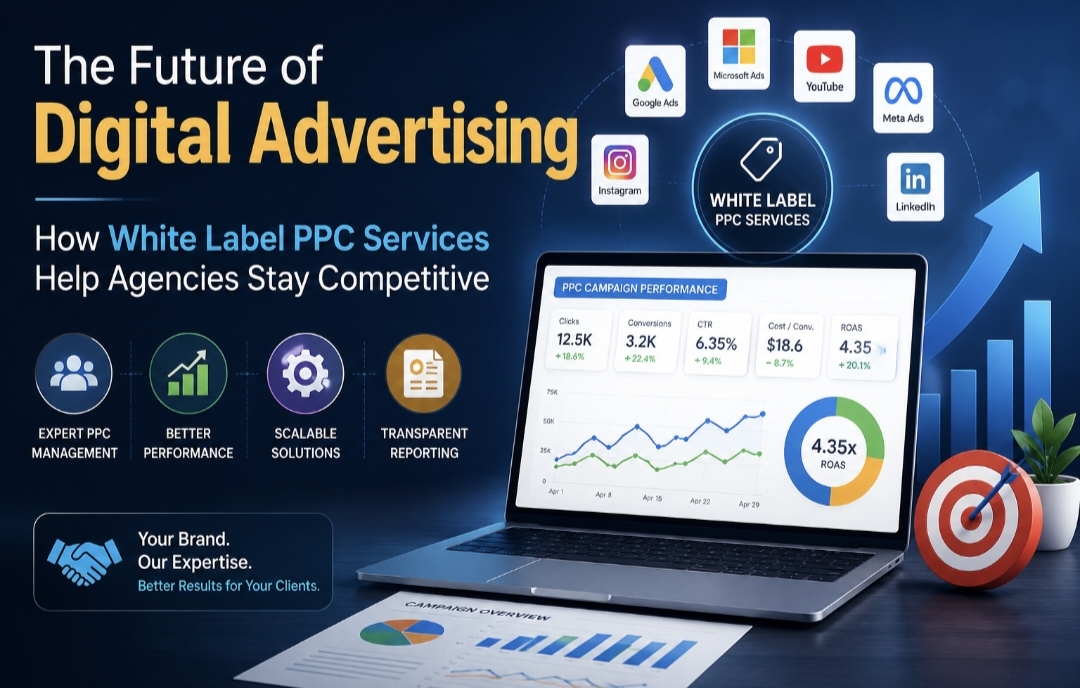
The digital advertising industry is growing rapidly, and businesses are spending more on paid ads to stay competitive online. Platforms like Google Ads, Microsoft Ads, YouTube, Facebook, Instagram, and LinkedIn are giving businesses more ways to reach customers, but managing campaigns across multiple platforms takes time, expertise, and consistent optimization.
To handle this growing demand, many agencies are using white label PPC services to manage campaigns without hiring a large in-house team. It helps agencies deliver better results, scale faster, and focus more on client communication and business growth while PPC experts handle campaign management, optimization, and reporting in the background.
The future of digital advertising is no longer centered only around visibility. It is now focused on data-driven targeting, automation, personalization, and real-time performance optimization. Businesses expect immediate results, transparent reporting, and consistent return on investment from their advertising spend. Agencies that fail to adapt to these expectations risk losing clients to competitors that can provide faster execution and stronger campaign performance.
One of the biggest reasons agencies are outsourcing PPC management is the growing complexity of advertising platforms. Google Ads alone now offers advanced bidding strategies, audience segmentation, AI-driven optimization, smart campaigns, remarketing systems, and conversion tracking features that require continuous monitoring and expertise. Managing these systems effectively demands dedicated professionals who understand both the technical and strategic side of paid advertising.
For smaller agencies, maintaining an internal PPC department can become expensive and difficult to scale. Hiring experienced PPC specialists, training staff, purchasing premium tools, and keeping up with industry changes requires significant investment. White label partnerships provide a practical solution by giving agencies access to skilled PPC experts without the overhead costs associated with building a full internal team.
Modern digital advertising also demands faster turnaround times. Clients expect campaigns to launch quickly, adapt rapidly, and deliver consistent results. Agencies working with white label PPC partners can often move much faster because they have access to dedicated teams that specialize solely in campaign management and optimization.
Another important factor driving this shift is the increasing demand for multi-platform advertising. Businesses are no longer focusing only on Google Ads. They now want integrated campaigns across search engines, social media platforms, video advertising networks, shopping campaigns, and display advertising systems. Managing all these channels effectively requires broad expertise and continuous optimization.
Today’s successful PPC campaigns often include:
- Google Search campaigns
- Google Display advertising
- YouTube video ads
- Facebook and Instagram campaigns
- LinkedIn B2B advertising
- Remarketing strategies
- Shopping campaigns
- Local service ads
Handling these advertising channels simultaneously requires advanced knowledge of audience targeting, budget allocation, conversion tracking, and creative optimization.
Artificial intelligence is also reshaping the future of paid advertising. Automated bidding systems, predictive analytics, audience behavior tracking, and machine learning algorithms now influence campaign performance heavily. While automation improves efficiency, it also increases the need for expert oversight. Automated systems still require strategic input, testing, optimization, and proper configuration to maximize return on investment.
Agencies that understand how to combine automation with human expertise are gaining a major competitive advantage. White label PPC providers often have dedicated specialists who continuously monitor trends, algorithm updates, and platform changes to ensure campaigns remain effective.
Client expectations are evolving as well. Businesses no longer judge agencies solely on clicks or impressions.
They now expect measurable business outcomes such as:
- Lead generation
- Revenue growth
- Lower acquisition costs
- Improved conversion rates
- Better return on ad spend (ROAS)
- Transparent reporting
- Faster campaign optimization
This shift has made performance marketing one of the most important aspects of digital advertising.
Another reason agencies are embracing outsourced PPC management is scalability. Growth often creates operational challenges for agencies. As client demand increases, agencies may struggle to onboard new staff quickly enough to maintain service quality. Delays in campaign management can lead to poor results and client dissatisfaction.
White label PPC partnerships solve this issue by allowing agencies to scale campaigns without dramatically increasing operational costs. Agencies can take on more clients confidently because campaign fulfillment is supported by experienced PPC professionals working behind the scenes.
The rise of data-driven marketing has also increased the importance of advanced analytics. Modern PPC campaigns rely heavily on conversion tracking, attribution modeling, audience segmentation, and behavioral analysis. Without proper tracking systems, businesses cannot accurately measure campaign success.
Professional PPC management now involves continuous analysis of:
- Keyword performance
- Search intent
- User behavior
- Audience demographics
- Device usage
- Geographic targeting
- Landing page performance
- Conversion paths
This level of optimization requires dedicated attention and technical expertise.
Landing page optimization has become another essential component of successful digital advertising. Even well-targeted ads can fail if users arrive on poorly optimized landing pages. Agencies increasingly need integrated strategies that combine ad management with conversion-focused landing page experiences.
This includes improving:
- Page speed
- Mobile responsiveness
- Call-to-action placement
- User experience
- Form optimization
- Content clarity
- Trust signals
The future of PPC is closely connected to overall user experience and conversion optimization rather than simple ad placement.
Mobile advertising continues to dominate digital traffic worldwide. Most users now interact with ads through smartphones and tablets, which means campaigns must be optimized specifically for mobile experiences. This includes shorter ad copy, fast-loading pages, click-to-call features, and location-based targeting.
Voice search and AI-powered search experiences are also beginning to influence keyword strategies. As users increasingly search through conversational phrases and smart assistants, advertisers must adapt their targeting strategies to align with evolving search behavior.
Privacy regulations and tracking limitations are creating additional challenges within digital advertising. Changes involving third-party cookies, data privacy laws, and platform restrictions are forcing agencies to rethink audience targeting and campaign measurement strategies.
Successful agencies are responding by focusing more on:
- First-party data collection
- Audience segmentation
- Customer retention strategies
- Server-side tracking
- Consent management
- Enhanced conversion tracking
These changes require ongoing technical expertise and strategic flexibility.
Video advertising is another area experiencing explosive growth. Platforms like YouTube, TikTok, Instagram Reels, and connected TV advertising are creating new opportunities for brands to engage audiences visually. Businesses increasingly expect agencies to offer video advertising management alongside traditional PPC campaigns.
Managing video campaigns requires understanding:
- Audience engagement metrics
- Creative performance
- View-through conversions
- Video retention analysis
- Cross-platform targeting
This growing complexity further highlights the value of specialized PPC expertise.
E-commerce advertising has also become more competitive. Shopping ads, dynamic remarketing, and product feed optimization now play a major role in online retail success. Agencies working with e-commerce brands often need advanced expertise in platforms such as Google Shopping, Meta Ads, and marketplace advertising systems.
As competition continues increasing, agencies must focus on delivering consistent results while maintaining profitability. Building large internal teams can quickly reduce profit margins due to rising labor costs, software expenses, and operational overhead.
White label partnerships help agencies remain lean and efficient while still delivering enterprise-level PPC services to clients.
The future of digital advertising will likely become even more automated, data-driven, and personalized. However, human expertise will remain critical for strategy development, audience understanding, creative testing, and campaign optimization.
Agencies that successfully combine advanced technology with experienced PPC management will be in the strongest position to grow in the coming years.
Choosing the right white label PPC partner is therefore becoming a strategic business decision rather than simply an outsourcing solution.
Agencies should look for providers that offer:
- Transparent reporting
- Strong communication
- Platform expertise
- Scalable support
- Conversion-focused strategies
- Industry experience
- Dedicated account management
- Flexible campaign solutions
Reliable partnerships help agencies improve service quality while strengthening long-term client relationships.
The digital advertising industry is moving toward a future where agility, performance, and expertise matter more than ever. Businesses expect faster results, better targeting, and measurable growth from every advertising dollar they spend.
Agencies that cannot scale efficiently or adapt quickly to changing advertising technologies may struggle to remain competitive in this evolving landscape.
Frequently Asked Questions (FAQ)
1. What are white label PPC services?
White label PPC services allow digital agencies to outsource pay-per-click campaign management to specialized PPC experts while presenting the service under their own brand name. This helps agencies offer professional PPC solutions without building a full in-house team.
2. Why are agencies outsourcing PPC management?
Many agencies outsource PPC management to reduce operational costs, improve campaign performance, scale faster, and gain access to experienced advertising specialists who understand advanced PPC strategies and platform updates.
3. Which platforms are commonly included in white label PPC management?
Most white label PPC providers manage campaigns across platforms such as Google Ads, Microsoft Ads, Facebook Ads, Instagram Ads, LinkedIn Ads, YouTube Ads, and shopping campaign networks.
4. How do white label PPC services help agencies grow?
White label partnerships help agencies expand service offerings, manage more clients efficiently, improve campaign quality, and reduce the need for additional in-house staff. This allows agencies to focus more on business growth and client relationships.
5. Are white label PPC services suitable for small agencies?
Yes. Small and mid-sized agencies often benefit the most because they can provide enterprise-level PPC management without the high cost of hiring and training internal PPC specialists.
6. How important is reporting in PPC management?
Reporting is extremely important because clients expect transparency and measurable results. Professional PPC management includes detailed performance reports covering conversions, ad spend, return on investment, click-through rates, and campaign growth.
7. Can white label PPC providers handle eCommerce advertising?
Yes. Many providers specialize in eCommerce PPC campaigns including Google Shopping Ads, dynamic remarketing, product feed optimization, and marketplace advertising strategies.
8. What should agencies look for in a white label PPC partner?
Agencies should evaluate factors such as industry experience, communication quality, platform expertise, scalability, reporting systems, campaign transparency, and proven performance history before selecting a white label PPC provider.
Conclusion
The future of digital advertising is being shaped by automation, real-time analytics, personalization, and performance-driven marketing strategies. As advertising platforms become more advanced and client expectations continue rising, agencies need scalable solutions that allow them to deliver exceptional results consistently.
White label PPC partnerships are helping agencies stay competitive by providing access to specialized expertise, faster campaign execution, improved scalability, and stronger operational efficiency. Instead of struggling with staffing limitations or increasing internal costs, agencies can focus on growth, client retention, and strategic business development.
As digital competition continues increasing across every industry, agencies that embrace flexible and performance-focused PPC solutions will be better positioned to thrive in the future of online advertising.