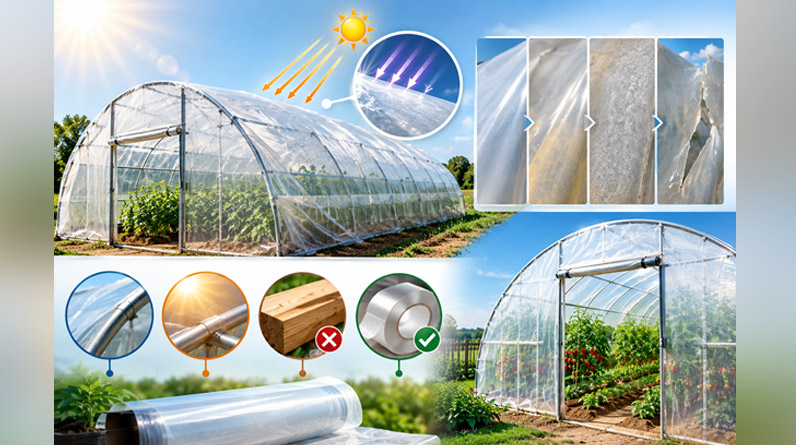
Sunlight is what you are really buying protection from
A cover gets judged on how clear it looks on the day it goes on, which is the one day its condition tells you nothing. What determines whether it is still serviceable three seasons later is how it handles ultraviolet light, and that is decided by additives you cannot see. A tunnel greenhouse grow tent rated in mils is describing thickness; the number that matters more is how many seasons the greenhouse film is rated to resist the sun.
What ultraviolet light actually does to the plastic
Polyethylene and EVA are long chains of molecules linked end to end. Ultraviolet photons carry enough energy to break those links, and each break shortens the chain a little. Shorter chains mean less flexibility, so the sheet slowly turns from something that stretches into something that cracks.
You can see the progression if you know where to look. The film yellows slightly, then loses its stretch, then develops a chalky surface, and only after all of that does it start splitting. By the time a tear appears on its own, the material has been failing for a year. Rubbing a finger along the outside is a fair field test: if it comes away dusty, the surface has already broken down and the sheet is into its last season whatever it looks like from indoors.
Where it goes first, and why
Degradation is not even across a cover. The south-facing slope takes far more total exposure than the north, so a greenhouse film usually fails on one side while the other still looks usable. The peak and the shoulders go before the sides.
Heat accelerates all of it. Where the film lies against a steel hoop that has been in the sun all afternoon, the plastic sits hotter than the air around it, and chemistry runs faster when it is hot. That contact line is where most covers eventually let go.
The avoidable mistakes
Two things shorten a greenhouse film faster than weather does:
- Treated lumber: certain preservatives attack polyethylene
- Standard PVC tape: plasticizers migrate into the film
Either one leaves a brittle stripe exactly where the material was touched, and the stripe usually tears before anything else on the structure does. Greenhouse-rated tape and a barrier strip between the film and any treated timber cost almost nothing, and they remove a failure mode that has nothing to do with the weather at all.
Planning the replacement instead of reacting to it
Because failure is gradual, the sensible approach is to treat a cover as a consumable with a known service life rather than waiting for a hole. Budget for replacement at the rated interval and change it in calm weather, not during the storm that finally opened it. Covers are far easier to fit on a still, mild day, and a planned change means the structure is never standing open while you wait on an order.
TMG Industrial supplies this size with six mil clear EVA film and roll-up sides, which is a reasonable specification for a structure meant to stay up year round. Whichever greenhouse film ends up over your hoops, keeping it tight, keeping it off hot steel and keeping incompatible materials away from it will do more for its working life than any extra thickness.