Every time you shop, you’re really choosing between two philosophies: buy cheap and replace often, or spend more once and keep it for years. Fast fashion looks like the clear winner if you only glance at the price tag. But run the numbers over a few years, and the story starts to look very different.
This isn’t just about being trendy or eco-conscious. It’s about where your money actually goes. Below, we break down what fast fashion and quality fashion really cost you, so you can decide which approach fits your budget and your conscience.
What Is Fast Fashion?
Fast fashion refers to inexpensive, trend-driven clothing that’s produced quickly and sold at low prices. Brands built on this model release new collections constantly, which encourages shoppers to buy often and toss items just as fast.
The appeal is easy to understand. Prices are low, and you never fall behind on whatever’s trending that week. But that low price often comes with a trade-off in quality, durability, and how long an item actually lasts in your closet.
What Is Quality Fashion?
Quality fashion takes the opposite approach. It focuses on durable materials, solid construction, and designs that don’t feel dated a year later.
Items like a well-made leather jacket, a tailored coat, or a sturdy pair of boots cost more at checkout. But they’re built to last for years, not months, and they hold their shape and style far longer than trend-driven alternatives. Shopping from a specialist source like The Leather Coats is a good example of this approach -every piece is made to be worn for years, not one season.
Breaking Down the Real Cost
Here’s where the fast fashion vs quality fashion debate actually gets interesting. The sticker price only tells part of the story.
Cost Per Wear
Cost per wear is a simple way to measure real value: take the price of an item and divide it by how many times you actually wear it.
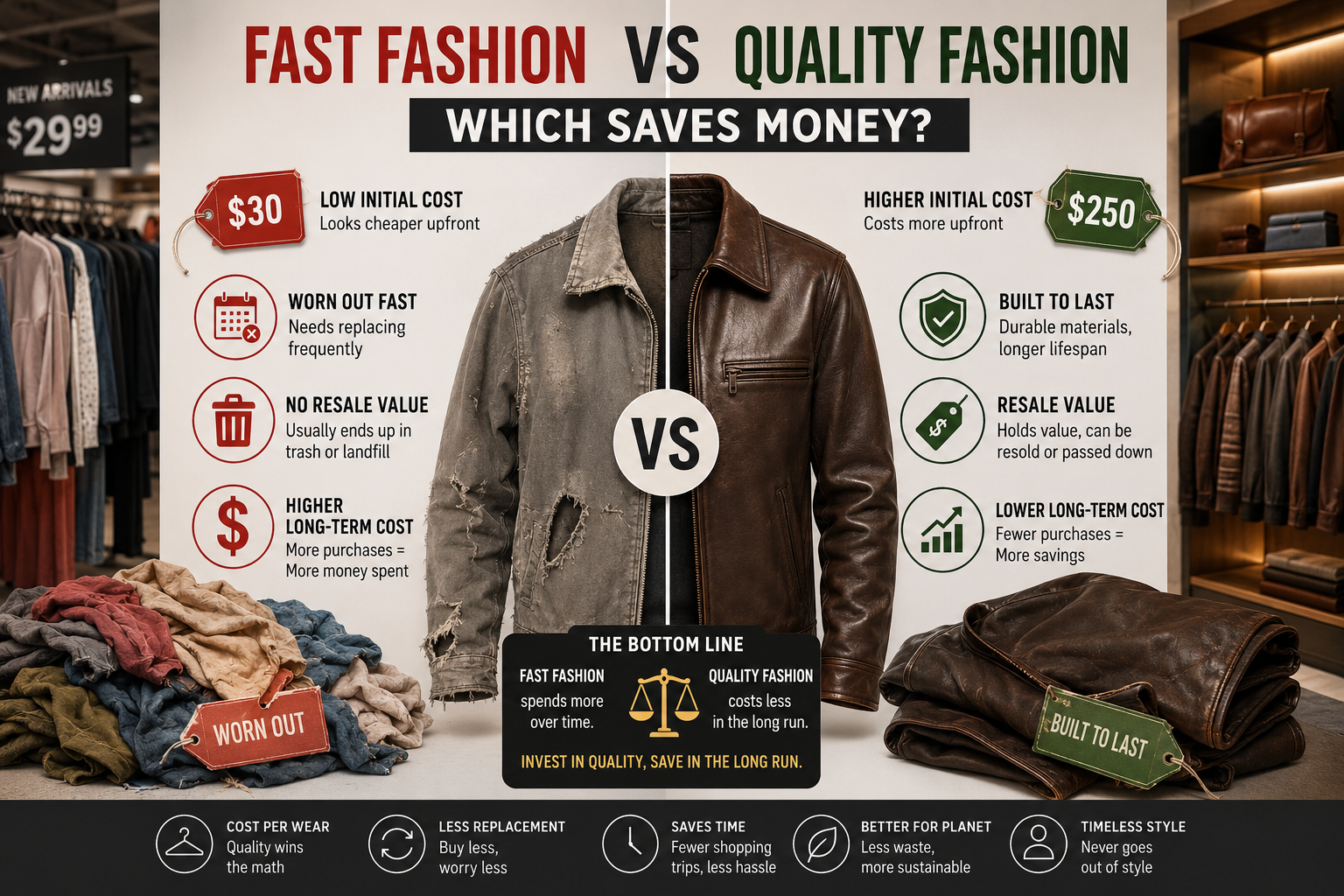
- A $30 fast fashion jacket that falls apart after 10 wears costs you $3 every time you put it on.
- A $250 leather jacket that lasts 5+ years and gets worn 300+ times costs less than $1 per wear.
Quality almost always wins this math, even though the upfront number looks scarier.
Replacement Frequency
Fast fashion items are designed around trend cycles, not durability. Because of that:
- Seams loosen after just a few wears.
- Fabric pills and thins out quickly.
- Zippers and buttons fail within a season or two.
That means constant repurchasing. Each item feels cheap on its own, but those small, frequent costs add up faster than most people realize.
Resale and Longevity Value:
Quality garments hold their value. A well-cared-for leather jacket can be resold, passed down, or simply worn for a decade without looking dated.
Fast fashion items, on the other hand, rarely have any resale value at all. Once they’ve worn out, they’re usually headed straight for the donation bin or the trash, adding to the growing pile of textile waste that ends up in landfills every year.
Hidden Costs:
Cheaper clothing often means more frequent shopping trips, more shipping fees, more returns, and more time spent replacing worn-out basics. Quality pieces cut down on this hidden “shopping tax” simply by lasting longer and needing to be replaced far less often.
Which One Actually Saves You Money?
If you’re buying for a single event or a short-lived trend, fast fashion can make sense. There’s little reason to spend big on something you’ll only wear once or twice.
But for wardrobe staples and outerwear – pieces you’ll wear season after season – quality fashion wins on cost-per-wear, durability, and long-term value. A well-fitted men’s leather jacket is a perfect example: it pairs with almost anything, works across multiple seasons, and doesn’t need replacing every year. Treating a purchase as an investment, rather than a disposable item, almost always pays off in the long run.
The Bottom Line
Fast fashion wins on upfront price. Quality fashion wins on long-term value. The rise of cheap, disposable clothing has driven both consumer spending and textile waste higher over the past two decades, and that trend shows little sign of slowing down.
If your goal is to genuinely save money over time – not just at checkout -investing in fewer, better-made pieces is almost always the smarter financial move.
FAQ
Is fast fashion actually cheaper than quality fashion?
Only in the short term. Fast fashion has a lower price tag, but it wears out faster and needs replacing more often. Once you calculate cost per wear, quality pieces frequently end up cheaper over months or years of use, even though they cost more upfront.
What does “cost per wear” mean?
Cost per wear is the price of an item divided by how many times you wear it. A cheap item worn only a handful of times can have a higher cost per wear than an expensive item worn hundreds of times, making it a more accurate way to judge value.
Is it worth spending more on a leather jacket?
For most people, yes. A well-made leather jacket can last five years or longer with proper care, works across multiple seasons, and holds its style far better than trend-driven alternatives, making it one of the better investment pieces in a wardrobe.
Does fast fashion have any resale value?
Generally, very little. Because it’s made from lower-quality materials and construction, fast fashion tends to show wear quickly, which limits its resale or donation value compared to well-made, durable garments.
How can I tell if a clothing item is good quality before buying it?
Check the stitching for even, tight seams, feel the fabric weight, inspect zippers and buttons for solid construction, and look at the material composition. Natural, durable materials and reinforced stress points are usually strong signs of quality.
Conclusion
Fast fashion and quality fashion solve two different problems. One saves you money today; the other saves you money over time. When you factor in cost per wear, replacement frequency, and resale value, well-made pieces usually come out ahead for anything you plan to wear regularly.
The smartest approach isn’t necessarily choosing one side completely – it’s knowing which category each purchase falls into. For your everyday staples and outerwear, though, investing in something built to last is almost always the better move for your wallet.