Why Summer 2026 is the Perfect Season to Hit the Himalayas
Ask any experienced trekker to name their favourite season in the mountains, and most will say summer without hesitation. Between May and September, the Indian Himalayas open up like nowhere else on earth. Snow bridges that held firm through winter begin to melt, high-altitude passes become accessible, wildflowers take over entire valleys, and the long daylight hours give you every opportunity to soak in the landscape at your own pace.
Yet summer trekking in India remains underestimated. Many first-timers still associate the Himalayas with winter snow treks, missing out on some of the most spectacular high-altitude routes that are only possible during the warmer months. If you are planning your next Himalayan adventure, 2026 is an outstanding year to do it. Trails are in excellent condition, booking windows are open, and several routes that faced weather disruptions in recent years are back to full operation.
Here is a carefully curated guide to the best summer treks in India for 2026 covering top-trending routes from Uttarakhand, Himachal Pradesh, Kashmir, and Sikkim, all available through Trekup India’s expanding network of guided departures.
1. Rupin Pass Trek Uttarakhand to Himachal Pradesh
If there is one summer trek in India that genuinely has everything: waterfalls, hanging villages, snowfields, glacial valleys, and a dramatic high-altitude pass crossing it is Rupin Pass. This is the trek that experienced trekkers recommend to each other quietly, almost protectively, because it deserves to be discovered rather than handed to you on a list.
The trail begins in Dhaula, Uttarakhand, and crosses into Sangla in Himachal Pradesh at a maximum altitude of 15,250 feet. What happens between those two points is nothing short of extraordinary. You pass through the picturesque village of Jakha, descend into a dense coniferous forest, emerge at the base of the famous Rupin Waterfall one of the tallest and most dramatic waterfalls in the Indian Himalayas and then push up through the Rupin Gully, a near-vertical snow climb that separates casual trekkers from committed ones.
The reward at the top is a panoramic world of glaciers, ridgelines, and the Kinner Kailash range spreading across the horizon. Few treks in India can match this combination of visual variety and physical challenge in a single route.
Why Rupin Pass is trending in 2026:
- One of the highest-rated pass-crossing treks in India for experienced trekkers
- Unique transition from Uttarakhand’s green terrain to Himachal’s alpine landscape
- The iconic Rupin Waterfall campsite a bucket-list overnight stop
- Best window: late May through early July before monsoon intensifies
2. Kashmir Great Lakes Trek The Crown Jewel of Summer Trekking
The Kashmir Great Lakes Trek has been one of the most searched trekking routes in India for the past several years, and it shows no signs of slowing down. Seven high-altitude alpine lakes, endless meadows carpeted in wildflowers, and 360-degree views of the Pir Panjal and Himalayan ranges make this one of the most visually rewarding treks on the planet, not just in India.
The route runs through the heart of the Kashmir Valley, beginning at Sonamarg and ending at Naranag (or vice versa), covering roughly 70 kilometres over six to seven days. Each day brings a completely different landscape. From the wide-open grasslands near Nichnai to the vivid blue of Gadsar Lake sitting beneath snow-streaked peaks, every campsite feels like a painting that changes colour as the light shifts.
July and August are the peak months for this trek, when the meadows are at their most vibrant and the wildflower display blue iris, red poppy, yellow buttercup is in full swing. Trekkers who make the effort to come during this window consistently call it one of the most beautiful two weeks of their lives.
What makes Kashmir Great Lakes unmissable:
- Seven distinct alpine lakes, each with its own character and colour
- Amongst the top Google-searched summer treks in India
- Vibrant wildflower bloom from mid-July to mid-August
- Remote, high-altitude terrain with limited commercial infrastructure a genuine wilderness experience
- Suitable for trekkers with some prior high-altitude experience
3. Valley of Flowers Trek A UNESCO World Heritage Site in Full Bloom
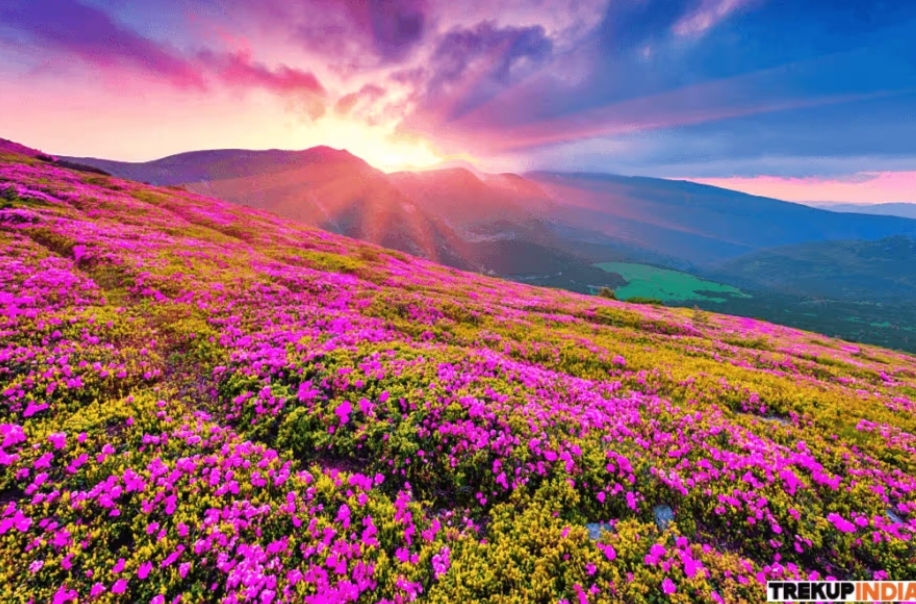
While the Valley of Flowers is covered in a winter context frequently, its true glory belongs entirely to the summer monsoon season. Between late June and mid-September, over 300 species of rare and endangered Himalayan wildflowers burst into bloom across this UNESCO World Heritage Site in Uttarakhand’s Garhwal region, creating one of the most jaw-dropping natural spectacles anywhere in Asia.
The trek itself begins at Govindghat near Joshimath and passes through dense forests and the roaring Pushpawati River before arriving at Ghangaria the base camp for both the Valley of Flowers and the sacred Sikh pilgrimage site of Hemkund Sahib. The main valley, just five kilometres from Ghangaria, is where the magic happens. Primulas, calendulas, orchids, Himalayan blue poppies, and Himalayan geraniums stretch as far as the eye can see, backed by glaciers and snow-dusted peaks.
This is one of those rare treks that genuinely moves people. It is not just about fitness or summits, it is about standing inside one of nature’s most extravagant seasonal displays and feeling completely overwhelmed by it.
Summer highlights:
- Over 300 documented rare and endangered flower species in bloom
- UNESCO World Heritage Site status globally recognised natural significance
- Optional day trip to Hemkund Sahib at 14,100 feet for a spiritual dimension to the trek
- Moderate difficulty accessible for fit beginners and experienced trekkers alike
- Rare wildlife sightings including blue sheep, red fox, and occasionally snow leopard
For full itinerary details, group departure dates, and pricing, visit the Valley of Flowers Trek page on Trekup India before the best summer slots fill up.
4. Goechala Trek Face to Face with Kangchenjunga
Sikkim doesn’t get nearly the attention it deserves as a trekking destination, and the Goechala Trek is the best argument for why that needs to change. This is the only trek in India that puts you face to face with Kangchenjunga, the world’s third-highest mountain, at a viewpoint so close the scale becomes genuinely hard to process.
The route runs through the Kanchenjunga Biosphere Reserve, passing through rhododendron forests that turn spectacular shades of red and pink in spring, high-altitude meadows at Dzongri, yak grazing grounds, frozen glacial lakes, and finally the Goechala viewpoint at over 15,000 feet. The approach is gradual enough to allow proper acclimatisation, making this one of the more safely manageable high-altitude treks of this difficulty level.
Summer, specifically April through June and again October through November is when Goechala delivers its finest views. Clear skies, manageable temperatures, and the post-monsoon freshness of the landscape combine to create trekking conditions that are hard to beat anywhere in the Himalayas.
Why Goechala is gaining traction in 2026:
- The closest trekking viewpoint to Kangchenjunga (8,586m) in India
- One of the most underrated high-altitude treks in the country
- Rich biodiversity inside the Kanchenjunga Biosphere Reserve
- Trekking through Dzongri one of the most scenic high-altitude meadows in Sikkim
- An ideal upgrade for trekkers who have completed routes like Kedarkantha or Hampta Pass
5. Hampta Pass Trek The Most Dramatic Landscape Crossover in India
No list of India’s top summer treks would be complete without Hampta Pass. What makes this route consistently one of the most booked treks in Himachal Pradesh is its extraordinary landscape contrast. You begin in the lush, green, river-fed Kullu Valley and, after five days of trekking, emerge into the barren, moonscape-like cold desert of Lahaul-Spiti. No other trek in India covers this kind of ecological transition in such a short distance.
At 14,100 feet, the pass itself sits on a narrow, windy ridge that serves as both a geographical and climatic border. Behind you, everything is green and alive. Ahead, everything is stripped back to rock, dust, and sky. It is one of the most surreal moments available to any trekker in India.
Summer opens the trail from June onward, when snow bridges over glacial rivers make the crossing possible and the meadows on the Kullu side fill with wildflowers. The famous 500-metre glissade where trekkers slide down the steep snow face of the Lahaul Valley on descent is one of the most genuinely fun moments on any Himalayan trail and is available only during the summer season.
To see upcoming departure dates, group availability, and complete trek details, browse the Hampta Pass Trek on Trekup India and book your slot well in advance summer batches fill up fast.
Summer Trekking Tips for 2026
Book early. The best summer departures especially for Kashmir Great Lakes and Rupin Pass fill up months in advance. If you have a specific date in mind, secure it now.
Train specifically for altitude. Summer treks often hit 14,000 to 15,000 feet. Your cardiovascular fitness needs to be solid before you arrive. Six to eight weeks of consistent running, hiking with a loaded pack, and stair training will make a significant difference on the trail.
Respect the monsoon. July and August bring heavy rainfall to most of the Western Himalayas. Pack waterproof gear for everything: jacket, bag cover, boots. Trails become slippery; rivers rise fast. Always follow your guide’s advice on timing and route adjustments.
Acclimatise properly. The biggest cause of trek failure and altitude sickness is moving too fast. Trust the itinerary. Rest day days exist for a reason. Hydrate consistently and report any symptoms of AMS (headache, nausea, dizziness) immediately.
Travel responsibly. Trekup India runs a Save The Trail initiative. Carry all waste out of the mountains, avoid single-use plastics on the trail, and follow Leave No Trace principles. The Himalayas are extraordinary because they have been treated with respect and help keep it that way.
How to Choose the Right Summer Trek for You
With so many outstanding routes available, the choice ultimately comes down to three things: your experience level, how much time you have, and what kind of landscape speaks to you.
If you are a first-time or early-stage trekker, the Valley of Flowers or Hampta Pass are ideal starting points both offer high-altitude drama without requiring advanced technical skills. If you have a few treks under your belt and want a genuine challenge, Rupin Pass or Kashmir Great Lakes will push you appropriately while delivering scenery that justifies every difficult step. If you are a seasoned trekker ready for your most ambitious Indian Himalayan adventure yet, Goechala is the logical next level.
Trekup India runs guided departures across all of these routes with experienced trek leaders, certified mountain guides, full safety protocols, and organised group batches making it easier than ever to find the right trek at the right time without navigating the logistics alone.
FAQs
1. Which is the best summer trek in India for 2026?
All five treks featured in this guide are exceptional, but Kashmir Great Lakes Trek and Rupin Pass Trek are currently among the highest-trending summer routes in India for 2026 based on search interest and booking demand.
2. When is the best time for summer trekking in the Himalayas?
May to June is ideal before the monsoon, and September to early October is excellent post-monsoon. July and August are great for specific routes like Kashmir Great Lakes and Valley of Flowers that are best experienced during peak wildflower season.
3. Is Goechala Trek suitable for beginners?
Goechala is best suited for trekkers with prior high-altitude experience, ideally having completed at least one or two treks above 12,000 feet. It is manageable but not a beginner route.
4. How far in advance should I book a summer trek in India?
For popular routes like Kashmir Great Lakes, Hampta Pass, and Rupin Pass, booking at least 2–3 months in advance is strongly recommended. Summer batches on these routes consistently sell out.
5. What fitness level is needed for high-altitude summer treks?
A solid baseline of cardiovascular fitness is essential. You should be comfortable running or brisk walking for 45–60 minutes continuously and able to handle uphill terrain with a 10–12 kg pack for 5–8 hours per day.