Family planning does not always follow a predictable timeline. Some people may want to delay pregnancy because of education, career plans, personal circumstances, relationship considerations, or medical treatment. As fertility changes with age, egg freezing can provide an option for preserving eggs for possible future use.
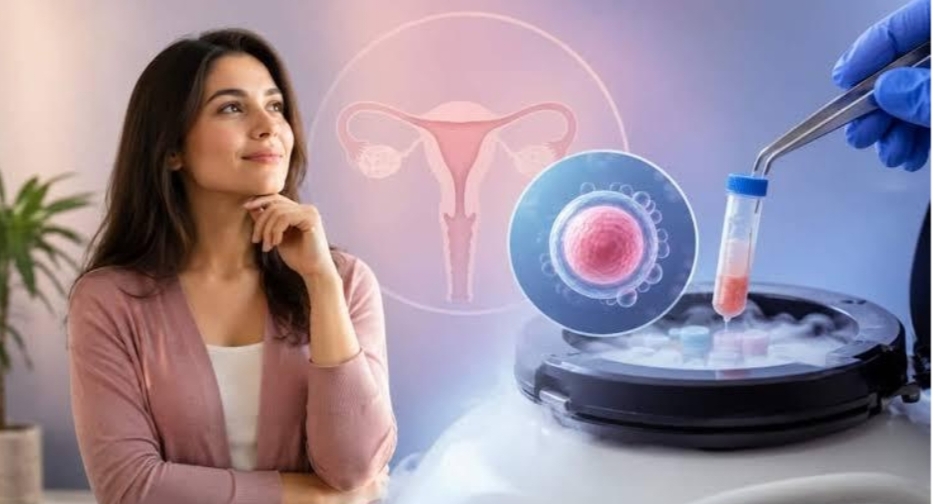
Egg freezing, medically known as oocyte cryopreservation, involves collecting mature eggs from the ovaries and preserving them at very low temperatures. If pregnancy is desired later, the eggs can potentially be thawed, fertilised with sperm, and developed into embryos for transfer.
However, egg freezing does not guarantee a future pregnancy. Its potential benefit depends on several factors, particularly age at freezing and the number and quality of eggs preserved.
What Is Egg Freezing?
Egg freezing is a fertility preservation procedure in which mature eggs are collected from the ovaries and rapidly frozen using a method called vitrification. The frozen eggs are stored until the person decides whether to use them.
Why Is Egg Freezing Considered?
Egg freezing may allow a person to preserve eggs at a younger age when egg quality is generally better than it may be later.
Potential reasons include:
- Delaying childbearing for personal reasons
- Planning around career or education
- Not currently having a suitable partner
- Preparing for certain medical treatments
- Conditions that may affect future fertility
- Other individual fertility-preservation considerations
It is important to discuss expectations with a fertility specialist because preservation does not eliminate age-related fertility considerations entirely.
How Age Affects Egg Freezing
Age is one of the most important factors when considering egg freezing. Both the number of available eggs and egg quality generally decline as a person gets older.
Why Earlier Preservation May Matter
Younger eggs generally have a lower likelihood of chromosomal abnormalities compared with eggs retrieved at later reproductive ages. This can influence the chance that a frozen egg may eventually result in a viable pregnancy.
However, there is no specific age at which egg freezing is guaranteed to work. A specialist may assess ovarian reserve, age, medical history, and reproductive goals before discussing whether preservation is likely to be useful.
Who May Consider Egg Freezing?
Egg freezing may be considered by people who want to preserve reproductive options for the future. It can be used for both personal and medical reasons.
Medical Fertility Preservation
Some medical treatments, particularly certain cancer treatments, can affect ovarian function. In appropriate cases, eggs may be collected and frozen before treatment begins.
Other medical conditions or procedures may also affect fertility. The timing can be especially important when treatment cannot be postponed for long.
For medical fertility preservation, referral to a fertility specialist should happen as early as possible so that available options can be discussed without unnecessarily delaying essential medical treatment.
The Egg Freezing Process
Egg freezing generally involves several stages. The entire process commonly takes a few weeks, although timing can vary depending on the individual’s menstrual cycle, treatment protocol, and clinical circumstances.
Step 1: Initial Fertility Assessment
The process usually begins with a consultation and assessment. The fertility team may review medical history, menstrual cycles, previous treatments, and reproductive goals.
Tests may include:
- Ultrasound
- Hormonal blood tests
- Ovarian reserve assessment
- Screening tests when appropriate
These evaluations help the specialist understand how the ovaries may respond to stimulation.
Step 2: Ovarian Stimulation
Medications containing fertility hormones are used to encourage the ovaries to develop multiple follicles rather than a single naturally selected follicle.
The response is monitored using ultrasound and sometimes blood tests. Medication doses may be adjusted according to the individual’s response.
Step 3: Egg Retrieval
When the follicles have developed appropriately, a final medication is given to help mature the eggs. Egg retrieval is then performed using a needle guided through the vagina with ultrasound.
The procedure is usually performed with sedation or anesthesia, depending on the clinical setting and patient needs.
Step 4: Freezing and Storage
After retrieval, the laboratory identifies suitable mature eggs. These eggs are rapidly frozen using vitrification and stored under carefully controlled conditions.
The eggs remain preserved until they are needed. Storage arrangements, costs, consent requirements, and applicable regulations should be discussed with the fertility centre beforehand.
What Happens When Frozen Eggs Are Used?
When a person decides to attempt pregnancy using stored eggs, the eggs are thawed in a fertility laboratory.
Fertilisation and Embryo Development
Because eggs do not always survive thawing or fertilise successfully, several steps are involved. A sperm may be injected directly into a mature egg using intracytoplasmic sperm injection, or ICSI.
If fertilisation occurs, the resulting embryo may be cultured for several days. An appropriate embryo can then be transferred into the uterus during a planned cycle.
Pregnancy testing is performed afterward according to the fertility team’s instructions.
How Many Eggs Should Be Frozen?
There is no universal number of eggs that guarantees a future pregnancy. The number considered appropriate depends on age, ovarian reserve, reproductive goals, and the possibility of future treatment.
Why Egg Number Matters
Not every frozen egg will:
- Survive thawing
- Fertilise
- Develop into an embryo
- Produce a chromosomally normal embryo
- Result in pregnancy
For this reason, specialists may discuss whether more than one egg-freezing cycle should be considered. The decision should be personalised rather than based on a fixed target for everyone.
Benefits and Limitations of Egg Freezing
Egg freezing can provide an additional reproductive option, but it should be viewed as fertility preservation rather than a guarantee of future parenthood.
Potential Benefits
Potential advantages include:
- Preserving eggs at a younger age
- Providing more flexibility around family planning
- Supporting fertility preservation before some medical treatments
- Allowing future use of one’s own eggs
Important Limitations
Egg freezing cannot guarantee pregnancy. The eventual outcome depends on egg age at freezing, number of eggs stored, egg survival, fertilisation, embryo development, uterine health, sperm factors, and other reproductive factors.
In Malad, people considering egg freezing treatment in Malad should discuss their age, ovarian reserve, expected response to stimulation, number of cycles, storage arrangements, future treatment process, costs, and realistic expectations with a qualified fertility specialist before undergoing the procedure.
Risks and Side Effects
Egg freezing involves hormonal medication and an invasive egg-retrieval procedure, so some temporary effects are possible.
Common Considerations
People may experience:
- Abdominal bloating
- Pelvic discomfort
- Breast tenderness
- Mood changes
- Injection-site discomfort
- Temporary ovarian enlargement
A less common but potentially serious complication is ovarian hyperstimulation syndrome, particularly with certain stimulation responses. The fertility team monitors patients to reduce risks and adjust treatment when necessary.
Egg retrieval also carries small procedural risks such as bleeding, infection, or injury to nearby structures.
Egg Freezing Does Not Stop the Biological Clock
A common misconception is that freezing eggs allows someone to completely stop reproductive ageing. The eggs may be preserved at their age when frozen, but the person’s uterus and overall health continue to age.
Pregnancy later in life may therefore involve additional considerations. A future pregnancy should be evaluated according to age, general health, medical history, and obstetric risks at that time.
Questions to Ask Before Freezing Eggs
Before beginning treatment, it is useful to understand both the medical and practical aspects of the process.
Important Questions Include
- What is my ovarian reserve?
- How many eggs might I reasonably expect to retrieve?
- Would one cycle be enough?
- What are the medication risks?
- How long will the eggs be stored?
- What happens when I want to use them?
- What are the additional costs?
- What are the chances of needing IVF later?
- Are there medical alternatives for fertility preservation?
Clear answers can help people make decisions based on realistic expectations rather than assuming egg freezing guarantees future fertility.
Conclusion
Egg freezing can be an important fertility-preservation option for people who want to maintain the possibility of using their own eggs in the future. It may be considered for personal family-planning reasons or before medical treatments that could affect ovarian function.
The potential benefit is strongly influenced by age at freezing, egg number, and egg quality. At the same time, frozen eggs do not guarantee a future pregnancy, and additional fertility treatment may be required when the eggs are eventually used.
A personalised consultation can help determine whether egg freezing fits an individual’s reproductive goals, health, timeline, and expectations.
Frequently Asked Questions
1. Is egg freezing a guarantee of future pregnancy?
No. Egg freezing preserves eggs but does not guarantee pregnancy. Some eggs may not survive thawing, fertilise, develop into embryos, or result in pregnancy. Age at freezing and the number of mature eggs stored influence future chances.
2. What is the best age to freeze eggs?
There is no single ideal age for everyone, but egg quality generally declines with age. Earlier preservation may offer advantages because younger eggs usually have a lower risk of chromosomal abnormalities.
3. How long can frozen eggs be stored?
Eggs can be stored for extended periods under appropriate cryopreservation conditions. Specific storage limits, consent requirements, regulations, and fees vary by location and fertility centre, so these details should be discussed before treatment.
4. Is egg retrieval painful?
Egg retrieval is generally performed with sedation or anesthesia, so significant pain during the procedure is uncommon. Mild pelvic discomfort, bloating, or cramping may occur afterward and usually improves during recovery.
5. Can frozen eggs be used for IVF later?
Yes. When someone decides to use stored eggs, they are thawed and fertilised in a laboratory, often using ICSI. Resulting embryos may then be transferred into the uterus following appropriate medical preparation.