Core Pillars of High-Performing Dermatology Marketing
The days of relying solely on traditional referrals are behind us. As of October 2026, the dermatology market is a thriving $8.9 billion industry, growing at a robust 6.94% annually. This highly competitive landscape demands sophisticated digital strategies to attract and retain patients. We understand that finding the right patients for your practice requires more than just a great reputation; it demands a proactive, specialized approach to advertising.
In this extensive guide, we will dive deep into the strategies that drive patient acquisition and practice growth. We’ll explore everything from building a high-converting website and dominating local search to mastering social media and leveraging PPC for dermatologists for immediate results. We’ll also cover essential topics like HIPAA compliance, reputation management, and how to measure your marketing ROI. Our goal is to equip you with the knowledge to navigate the complex world of online advertising, ensuring your practice stands out and thrives.
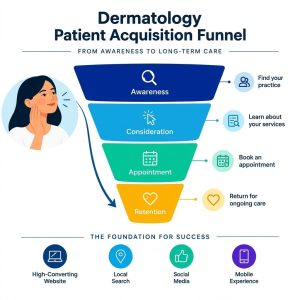
In today’s digital-first world, a strong online presence is non-negotiable for dermatology practices. Achieving high search visibility and securing those coveted page 1 rankings are crucial for attracting new patients. Beyond just being found, establishing brand consistency across all platforms builds patient trust and reinforces your practice’s professionalism. The goal is to streamline the patient journey from initial search to online scheduling, making it as seamless as possible.
Optimizing Web Assets and Mobile Experience
Your practice’s website is often the first point of contact for potential patients, making it your most valuable digital asset. With over 60% of medical website traffic now originating from smartphones, mobile optimization isn’t just a best practice—it’s a necessity. A slow, clunky, or non-responsive website will deter prospective patients, regardless of the quality of care you offer. We prioritize fast load times, clear navigation, and a user-friendly interface across all devices.
To ensure your website is a high-converting machine, we focus on strategic call-to-action (CTA) placements. These aren’t just “Contact Us” buttons; they are carefully designed prompts that guide the patient toward their next step.
Here are some high-converting call-to-action strategies for dermatology clinic websites:
- Prominently Displayed “Book Appointment Online” Button: Make it easy for patients to schedule instantly, often in the header or sidebar.
- “Request a Consultation” Form: For more complex or cosmetic procedures, a form allows patients to express interest without immediate commitment.
- “Call Now” Button (Mobile-Optimized): On mobile devices, a click-to-call feature is essential for immediate inquiries.
- “Download Our Free Skincare Guide” (Lead Magnet): Offer valuable content in exchange for an email address, nurturing leads.
- “View Our Services” or “Explore Treatments” Buttons: Guide patients directly to detailed information about your offerings.
- “Meet Our Doctors” or “About Our Practice”: Build trust and connection by encouraging patients to learn about your team.
- “See Before & After Gallery”: For cosmetic services, visual proof is highly persuasive.
- “Read Patient Testimonials”: Showcase positive experiences to build social proof.
Local Search and Google Business Profile Growth
For dermatologists, attracting patients from within your geographic area is paramount. This is where local SEO and an optimized Google Business Profile (GBP) become indispensable. When potential patients search for “dermatologist near me” or “acne treatment [your city],” you want your practice to appear at the top of the search results, ideally in the local “map pack.”
Optimizing your GBP involves more than just claiming your listing. It requires:
- Complete and Accurate Information: Ensure your name, address, phone number, website, and hours are consistent across all online directories.
- Geo-Targeted Keywords: Integrate keywords relevant to your services and location into your GBP description and posts.
- High-Quality Photos: Showcase your clinic, staff, and services with professional images.
- Regular Posts: Use the GBP posting feature to share updates, promotions, and health tips.
- Service Listings: Clearly list all the medical and cosmetic dermatology services you offer.
- Review Generation and Management: Actively solicit patient reviews and respond to them promptly and professionally. Positive reviews are a significant ranking factor and build immense trust.
- Local Citations: Ensure your practice information is consistent across other online directories like Yelp, Healthgrades, and local business listings.
By meticulously managing your GBP and implementing a robust local SEO strategy, we can significantly enhance your visibility to nearby patients actively seeking dermatology services.
Strategic PPC for Dermatologists: Capturing High-Intent Patients
While organic search engine optimization builds long-term visibility, paid advertising offers an immediate way to capture high-intent patients actively searching for your services. Strategic PPC for dermatologists involves more than just bidding on keywords; it’s about understanding search intent, crafting compelling ad copy with relevant extensions, and driving traffic to optimized landing pages that convert visitors into appointments. This approach allows for precise targeting and measurable results, giving you control over your patient acquisition efforts. For a deeper dive into the fundamentals of paid advertising for dermatologists, exploring comprehensive guides can be incredibly beneficial.
Structuring High-Converting PPC for Dermatologists Campaigns
Effective PPC campaigns are built on a foundation of meticulous planning and continuous optimization. We focus on several key elements to ensure your ad spend yields the best possible return:
- Keyword Match Types: We strategically use broad match modifiers, phrase match, and exact match keywords to control who sees your ads, minimizing wasted spend on irrelevant searches.
- Negative Keywords: Just as important as what you bid on is what you exclude. We identify and add negative keywords to prevent your ads from showing for unrelated searches (e.g., “dermatologist salary” or “free skin care tips”).
- Geo-Fencing and Location Targeting: We precisely target potential patients within your service area, ensuring your ads reach the right local audience.
- Compelling Ad Copy: We craft ad headlines and descriptions that highlight your unique selling propositions, special offers, and the specific benefits patients will receive.
- Ad Extensions: Utilizing extensions like call buttons, location information, structured snippets, and sitelinks enhances ad visibility and provides more opportunities for interaction.
- Bid Strategies: We employ smart bidding strategies optimized for conversions, ensuring your budget is spent efficiently to acquire new patients.
- Quality Score: By improving ad relevance, landing page experience, and expected click-through rates, we boost your Quality Score, which can lower your cost-per-click and improve ad positioning.


Medical vs. Cosmetic Dermatology Paid Search Tactics
The approach to paid advertising differs significantly between medical and cosmetic dermatology services, reflecting the distinct patient journeys and motivations.
Feature Cosmetic Dermatology Advertising Medical Dermatology Advertising Patient Intent Elective, aesthetic improvement, self-enhancement Problem-solving, health concern, pain/discomfort relief Keywords “Botox near me,” “lip fillers,” “body contouring,” “laser skin resurfacing,” “anti-aging treatments” “acne treatment,” “skin cancer screening,” “eczema specialist,” “mole removal,” “psoriasis doctor” Ad Copy Focus Benefits (e.g., “Rejuvenate Your Look,” “Boost Confidence”), before-and-after results, special offers Urgency (e.g., “Early Detection,” “Relief from Itching”), expertise, compassionate care, insurance acceptance Landing Pages Visually rich, before-and-after galleries, testimonials, pricing info (if applicable), consultation forms Detailed service descriptions, doctor bios, patient education, insurance details, appointment booking Targeting Demographics (age, income), interests (beauty, wellness), lookalike audiences Condition-specific, local, urgent care keywords, health-related behaviors Platforms Google Ads, Facebook, Instagram (highly visual) Google Ads (Search Network), local directories, health-focused platforms Conversion Goal Consultation booking, procedure scheduling Appointment booking, diagnostic visit For cosmetic services like Botox, fillers, or body contouring, our campaigns emphasize aspirational messaging, visual appeal, and the transformative benefits. We often leverage platforms like Instagram and Facebook with highly targeted visual ads. In contrast, medical dermatology campaigns for conditions like acne treatments, skin cancer screenings, or eczema focus on expertise, relief, and the importance of timely care, primarily utilizing Google Search Ads to capture immediate problem-solving intent.
Omnichannel Patient Acquisition Beyond Search Ads
A truly effective advertising strategy for dermatologists extends beyond just search ads. An omnichannel approach ensures brand awareness, nurtures patient relationships, and drives long-term patient retention, ultimately increasing their lifetime value to your practice. By engaging with patients across multiple touchpoints, we build a stronger community around your brand.
Social Media Marketing and HIPAA-Compliant Proof
Social media platforms like Instagram, TikTok, and Facebook are powerful tools for dermatologists to educate, engage, and attract new patients. However, navigating these platforms requires strict adherence to HIPAA compliance, especially when sharing patient-related content.
- Instagram Marketing: Ideal for showcasing aesthetic results, sharing skincare tips, and “day in the life” content. High-quality before-and-after photos (with explicit patient consent) are highly effective.
- TikTok Skin Education: Dermatologists are finding success on TikTok by creating short, engaging videos that debunk skincare myths, explain procedures, and offer quick tips. This platform is excellent for reaching younger demographics.
- Facebook Engagement: Facebook remains valuable for community building, sharing longer-form content, event promotion, and targeting specific local demographics.
When it comes to sharing patient testimonials or before-and-after photos, HIPAA compliance is paramount. We implement rigorous guidelines:
- Explicit, Written Consent: Always obtain clear, written authorization from patients specifically for the use of their photos or testimonials in marketing materials, specifying where and how the content will be used.
- Anonymity: Ensure patient anonymity is maintained, even with consent, by avoiding identifying information unless explicitly agreed upon.
- No Protected Health Information (PHI): Never share any PHI without proper authorization.
- Secure Storage: Ensure all consent forms and patient data are stored securely.
Leveraging Video, AI Search, and Lifecycle Email Marketing
Beyond social media, other digital channels offer significant opportunities for dermatologists.
- YouTube Video Marketing: A powerful platform for educational content. Dermatologists can create videos explaining procedures, answering common patient questions, showcasing clinic tours, or providing in-depth skincare routines. This builds authority and can rank well in Google Search results.
- Optimizing for AI-Driven Search: As AI becomes more integrated into search engines and virtual assistants, optimizing your content for conversational queries is crucial. This means providing clear, concise answers to common questions in your website content and videos, using natural language that AI can easily interpret.
- Lifecycle Email Marketing: Email remains one of the most effective channels for nurturing patient relationships and encouraging repeat visits. We implement automated workflows for:
- Welcome Series: New patient onboarding, practice information.
- Appointment Reminders: Reducing no-shows.
- Post-Treatment Follow-ups: Care instructions, product recommendations.
- Seasonal Promotions: Highlighting relevant services (e.g., summer sun protection, winter skin hydration).
- Educational Newsletters: Sharing valuable skincare insights and practice updates. We segment email lists by demographics or service interest (e.g., cosmetic vs. medical) to deliver highly personalized and relevant content, boosting engagement and conversions.
- Direct Mail Integration: While digital is dominant, targeted direct mail can still complement digital efforts, especially for local promotions or reaching specific demographics less active online.
Maximizing ROI and Avoiding Costly Practice Pitfalls
Investing in advertising should always lead to measurable growth. We focus on robust performance tracking to understand patient acquisition cost (PAC) and return on ad spend (ROAS). For multi-location practices, this also involves managing campaigns effectively across different geographies and ensuring staff are adequately trained to handle incoming leads.
Common Pitfalls in PPC for Dermatologists and How to Avoid Them
Even with the best intentions, certain mistakes can quickly deplete an advertising budget without yielding results. We help dermatologists steer clear of these common pitfalls:
- Broad Targeting Waste: Relying on overly broad keywords or demographic targeting can lead to your ads being shown to irrelevant audiences, wasting clicks and budget. Avoid this by using specific keyword match types and detailed audience segmentation.
- Unoptimized Landing Pages: Sending ad traffic to a generic homepage instead of a dedicated, conversion-focused landing page for that specific service will result in high bounce rates and low conversion rates. Ensure every ad campaign has a highly relevant, optimized landing page with a clear call to action.
- Ignoring Negative Keywords: Failing to continuously add negative keywords means your ads will appear for irrelevant searches, costing you money. Regularly review search term reports and add new negative keywords.
- Compliance Violations: Ignoring HIPAA or advertising regulations can lead to severe penalties and reputational damage. Always prioritize compliance in all marketing materials and strategies.
- Slow Lead Follow-up: Even the best marketing generates leads that will go cold if not followed up promptly. Implement a system for rapid lead response, ideally within minutes of inquiry.
Data Analytics, Tracking, and Budget Allocation
Measuring the effectiveness of your advertising efforts is crucial for continuous improvement and maximizing ROI. We implement comprehensive tracking mechanisms:
- Call Tracking: Assign unique phone numbers to different campaigns or channels to accurately attribute phone calls to their source.
- Google Analytics 4 (GA4): Configure GA4 to track website user behavior, conversion events (e.g., appointment bookings, form submissions), and traffic sources.
- Conversion Tracking: Set up conversion tracking within Google Ads and other platforms to monitor which ads and keywords are driving desired actions.
- Budget Modeling: Develop a clear budget model that allocates resources across different channels based on performance data and strategic goals.
- Patient Lifetime Value (LTV): Understand the average revenue a patient generates over their relationship with your practice to justify higher acquisition costs for certain services.
- Revenue Attribution: Use data to understand which marketing touchpoints contribute to a patient’s journey, allowing for more informed budget allocation.
By meticulously tracking these metrics, we can identify what’s working, optimize underperforming campaigns, and ensure every dollar spent on advertising contributes to your practice’s growth.
Frequently Asked Questions about Dermatology Advertising
What is the average budget required for dermatology PPC campaigns?
The budget for dermatology PPC campaigns can vary significantly based on your practice’s location, the competitiveness of your services (especially cosmetic vs. medical), and your growth goals. Ad spend allocation typically starts from a few hundred dollars to several thousand per month. Cost-per-click (CPC) averages for dermatology keywords can range from a few dollars to upwards of $20-$30 for highly competitive cosmetic terms like “Botox” or “lip fillers.” We recommend starting with a conservative budget to gather data, then scaling up based on performance. A good rule of thumb is to allocate enough budget to generate a meaningful number of clicks and conversions to allow for proper optimization. Local market sizing and the number of services you wish to promote will heavily influence the total ad spend.
How can dermatologists ensure HIPAA compliance in digital advertising?
Ensuring HIPAA compliance in digital advertising is critical to protect patient privacy and avoid legal repercussions. Key strategies include:
- No Protected Health Information (PHI) in Ads: Never include PHI in ad copy, landing pages, or tracking pixels without explicit patient consent.
- Secure Forms: Use HIPAA-compliant forms for any online inquiries or appointment requests that collect patient data.
- Signed Releases for Testimonials/Photos: Obtain specific, written, and revocable consent from patients before using their testimonials or before-and-after photos in any public-facing marketing.
- Tracking Pixels and Data Sharing: Be cautious with tracking pixels (e.g., Facebook Pixel, Google Ads conversion tracker) that might inadvertently share PHI with third-party platforms. Consider server-side tracking or privacy-enhanced conversion APIs where possible, or ensure data is de-identified.
- Privacy Policies: Have a clear, accessible privacy policy on your website explaining how patient data is collected, used, and protected.
- Staff Training: Educate all staff involved in marketing about HIPAA regulations and best practices.
What is the expected timeline to see a positive ROI from dermatology advertising?
The timeline to see a positive return on investment (ROI) from dermatology advertising varies depending on the strategy employed.
- Paid Search (PPC): Generally offers the most immediate results. You can start seeing leads and appointments within days or weeks of launching campaigns. A positive ROI can often be achieved within 1-3 months, provided campaigns are well-optimized.
- Organic SEO: This is a longer-term strategy. While foundational, it can take 6-12 months, or even longer in highly competitive markets, to achieve significant organic rankings and traffic that translate into a strong ROI.
- Social Media & Content Marketing: Building an audience and generating consistent leads through these channels can take 3-6 months to gain traction, with ROI improving steadily over time as your authority grows.
- Lead Nurturing & Email Marketing: The ROI from these efforts is often seen over the patient’s lifetime, as they encourage repeat visits and referrals. Initial returns might be visible within a few months, but the full impact compounds over years.
Overall, a holistic approach that combines immediate tactics like PPC with long-term strategies like SEO and content marketing is essential for sustainable growth and a robust ROI over time.
Conclusion
In the dynamic landscape of October 2026, a dermatologist’s success hinges on a sophisticated and adaptable advertising strategy. The era of passive patient acquisition is over; proactive digital engagement is the new standard. By embracing a holistic advertising approach that encompasses a high-converting website, robust local SEO, targeted PPC campaigns, HIPAA-compliant social media, and nurturing email marketing, your practice can achieve remarkable growth. Continuous optimization, driven by data analytics and a keen understanding of patient needs, ensures that your marketing efforts remain efficient and effective. Investing in these specialized strategies will not only attract new patients but also solidify your practice’s digital authority, fostering sustainable growth and a thriving patient base for years to come.