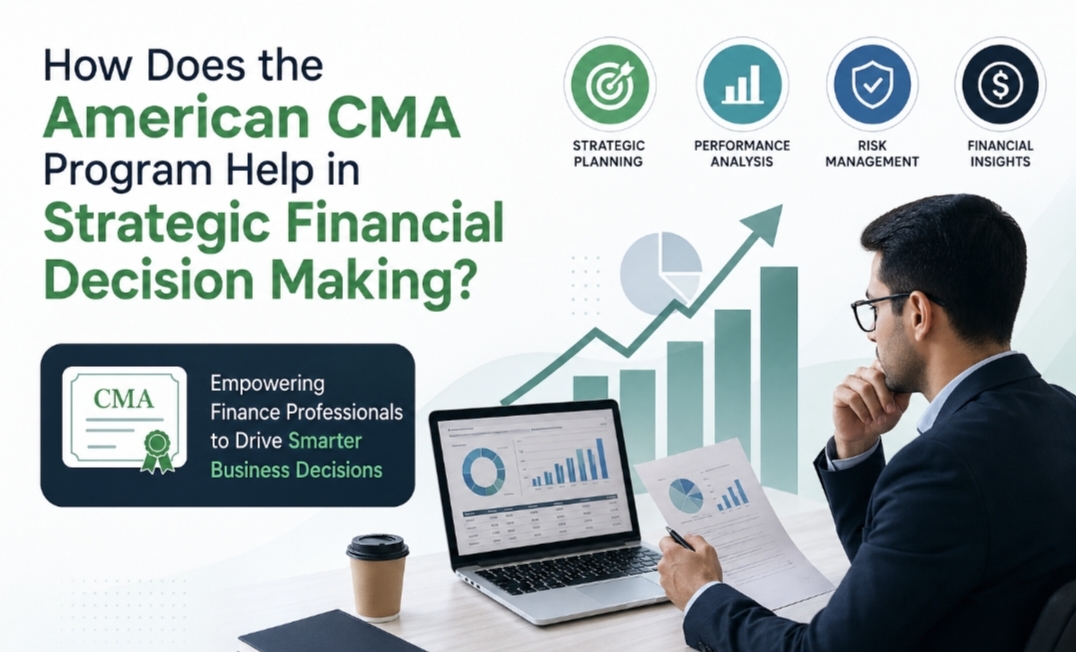
The Certified Management Accountant course is designed to equip finance professionals with the strategic mindset required to drive business decisions. Unlike conventional accounting qualifications that emphasise reporting and compliance, the American CMA emphasises management accounting, performance analysis, and financial planning. This enables the professional to analyze financial data beyond the figures and transform it into useful information that can be used in the long-term objectives of the business.
The emphasis placed on aspects such as budgeting, risk management, forecasting, and internal control in the CMA program helps the professional make strategic decisions. The program helps the professional develop critical skills such as data analysis and cost optimization. This enables the professional to analyze business opportunities and challenges. Therefore, professionals play an important role in advising on business strategy, improving financial performance, and helping the business make well-informed, forward-thinking decisions.
7 Ways the American CMA Course Supports Strategic Financial Decision-Making
1. Financial Planning and Analysis (FP&A) Foundation
The Certified Management Accountant program helps professionals gain in-depth knowledge of financial planning, budgeting, forecasting, and variance analysis. These are essential skills for determining the financial condition of any company and areas of improvement in the company’s performance. The professionals learn to interpret financial data and use it to make decisions for the betterment of the company.
Using this knowledge, professionals can help companies make decisions using data instead of intuition. The financial experts of the company play an important role in ensuring that all the financial decisions made by them are in line with the strategic objectives of the company.
2. Expertise in Cost Management & Control
The American CMA course is designed to educate professionals in the field of cost management, as it is an essential element that enables them to understand the behaviour of costs and attain cost optimisation and distribution. This knowledge enables them to identify inefficiencies and implement cost-saving strategies without compromising quality or productivity.
Using these tools, professionals can support pricing strategies, budgeting decisions, and other operational improvements. The professionals’ capacity to control and optimize costs is significant to the bottom line of the company and makes them integral in decision-making processes in the firm.
3. Data-Driven Decision Making with Analytics
CMA is a course based on data analytics for making financial decisions. The professionals are trained in the assessment of large amounts of data and in making appropriate conclusions from the data analyzed.
In the current digital economy, businesses rely on data to be competitive. Professionals tend to bridge the gap between finance and analytics, allowing companies to make proactive decisions, mitigate risks and capitalize on emerging opportunities.
4. Strategic Performance Management
The Certified Management Accountant program also includes the evaluation tools such as Key Performance Indicators (KPI), balanced scorecard, and benchmarking. The evaluation tools enable professionals to measure the company’s performance and identify areas for improvement.
In addition, professionals leverage these insights to recommend strategies that improve efficiency and productivity. By constantly keeping track of the performance metrics, they are able to ensure that the business strategies are in line with the changing market conditions and the goals of the business.
5. Risk Management & Internal Controls
Risk evaluation and internal control frameworks are also part of the Certified Management Accountant program. The professionals learn how to identify the financial risks and mitigate them to protect the business strategies.
Expertise in risk evaluation helps professionals make decisions by eliminating uncertainty. The professionals can also ensure the implementation of internal controls to avoid any violations and fraud.
6. Investment Decision & Capital Budgeting Skills
The CMA program helps professionals develop the skills required to assess business opportunities by utilizing techniques such as Net Present Value (NPV), Payback Analysis, and Internal Rate of Return (IRR).
These are critical in ensuring that sound capital investment decisions are made. The principles assist professionals in evaluating the project’s viability. This helps them in evaluating the viability of the project in line with the business strategy for the best returns.
7. Leadership & Business Strategy Integration
The Certified Management Accountant program delivers essential skills but also teaches candidates leadership abilities, communication expertise, and strategic thinking skills. The professional is able to work effectively within a team of diverse functions and contribute to discussions at the highest level of business.
Furthermore, professionals serve as strategic advisors to management, providing financial insights that inform business strategy. Their ability to relate financial data to business goals makes them key players in driving organisational success.
Conclusion
The American CMA program helps a professional acquire appropriate financial skills, strategic skills, and analytical skills, allowing them to make appropriate business decisions that help the business grow. The program covers areas such as financial planning, performance management, and analysis to ensure that the professional does not limit themselves to accounting alone, but also helps the business grow.
This broad knowledge base helps the professional align their financial goals with their business goals and deal with complex financial issues. Are you prepared to advance in your career? Reach out to Zell Education’s team and start your journey to become a Strategic Financial Leader!
FAQs
1. What skills are developed in the CMA program to support the process of strategic decision-making?
The CMA program develops the ability to perform financial analysis, manage risk, and create plans and performance measures to support informed decision-making.
2. Do Certified Management Accountants assist in the business strategy process?
Professionals play an important role in integrating business strategy with the overall financial perspective.
3. How does the American CMA improve the ability to perform financial planning?
The ability to create budgets, forecasts, and business strategies is developed.