Console game development in 2026 is no longer an extension of PC or mobile workflows. As the global gaming market accelerates toward $618.82 billion by 2030 at a 12.5% CAGR, studios are under pressure to ship console titles that meet strict performance budgets, platform rules, and certification standards. Choosing the right console game development companies is now a strategic production decision, not a tactical outsourcing choice.
Xbox, PlayStation, and Nintendo Switch each impose distinct technical, compliance, and optimization requirements, from memory ceilings and frame stability to TRC, XR, and Lotcheck approvals. Studios that treat consoles as just another build target often face submission failures, delayed launches, or expensive rework cycles.
In this blog, we’ll discuss what console development truly requires in 2026, how to evaluate console-first studios based on certification and performance maturity, and which companies consistently deliver compliant, scalable, and production-ready console titles.
TL;DR (Quick Summary)
Top console game development companies in 2026 are defined by shipped titles, platform certification maturity, performance optimization expertise, and structured execution models. Console production demands compliance discipline, optimization depth, and long-term ownership of delivery that go beyond general game development.
Studios that combine co-development capability with full-cycle console execution provide the strongest risk-adjusted outcomes. For teams seeking a co-development partner with a history of console shipping and structured delivery pipelines, Juego Studios is a strong strategic choice.
Key Takeaways
- Console development differs from PC and mobile due to certification cycles, fixed hardware performance budgets, and platform compliance enforcement.
- The best engagement model depends on scope, but co-development and structured studio partnerships significantly reduce certification and submission risk.
- Indie console titles often begin around $300K+, while AA and AAA budgets scale into multi-million-dollar ranges.
- Juego Studios stands out for combining co-development maturity with full-cycle console delivery discipline across Xbox, PlayStation, and Switch ecosystems.
- Key risks include underestimating certification timelines, ignoring performance ceilings, and hiring partners without shipped console experience.
- Co-development models perform best when projects involve multi-platform launches, system-heavy builds, or long-term LiveOps continuity.
What Console Game Development Actually Involves in 2026
Console game development in 2026 is a tightly governed production discipline shaped by hardware limits, certification requirements, and platform-holder oversight. Unlike PC, where configurations vary, console development operates within fixed performance ceilings that influence architecture, design, and scheduling decisions from pre-production onward.
Modern console projects are built around platform realities that cannot be bypassed. Studios that design for these constraints early maintain production stability, while those that treat compliance as a final step absorb avoidable delays and rework.
Fixed Hardware Targets
Console titles must operate within predefined CPU, GPU, and memory budgets. There is no hardware variability cushion, and performance cannot rely on scaling presets. Systems must be optimized specifically for Xbox, PlayStation, or Switch constraints from day one.
Certification-Driven Pipelines
Console production revolves around TRC (Technical Requirements Checklist), XR compliance, and Nintendo Lotcheck approvals. These cover save behavior, suspend-resume logic, achievement integration, storefront flows, error handling, and platform UX expectations. A game can be rejected even if the content quality is high.
Performance as a Gating Factor
Frame pacing, load times, memory spikes, and streaming behavior are validated continuously on devkits. Performance is not a polish phase. It is a gating requirement that determines whether submissions are approved and accepted by the platform.
Parallel Compliance and Content Tracks
Console builds require content progression and certification readiness to move in parallel. Teams must manage gameplay iteration while preparing submission documentation, regression tracking, and compliance validation simultaneously.
Long-Term Delivery Ownership
Console launches assume Day One patches, DLC expansion, system updates, and post-launch maintenance. Studios must structure patch pipelines and regression safeguards without destabilizing certification status.
These boundaries fundamentally change how teams estimate scope, staff engineering, and plan timelines. Console production rewards early discipline and penalizes reactive optimization.
Core Capabilities That Define Top Console Game Development Companies
Not all game studios are equipped to produce for consoles. The best console game development companies distinguish themselves through platform fluency, engineering depth, and structured delivery ownership aligned with certification realities.
- Platform Compliance Expertise: Top studios demonstrate repeated experience navigating Xbox, PlayStation, and Nintendo certification without relying on trial-and-error resubmissions. They understand platform documentation, submission workflows, and the enforcement of technical requirements.
- Performance-First Engineering Culture: Console-focused teams design gameplay systems around stable frame rates and memory ceilings from the prototype stage. Optimization is embedded into development, not postponed until content freezes.
- Devkit and SDK Proficiency: Mature console studios work directly with platform SDKs, devkits, profiling tools, and debugging environments throughout production. This reduces performance surprises and submission friction near launch.
- Structured QA and Submission Workflows: Console QA integrates regression tracking, automated builds, compliance checklists, and certification-ready documentation. Top teams treat submission readiness as a continuous workflow rather than a final checkpoint.
- Cross-Discipline Production Alignment: Engineering, art, design, and QA operate within tightly synchronized pipelines. Misalignment across departments is one of the most common causes of certification delays and performance regressions.
- Scalability Beyond Individuals: Console production cannot depend on a single freelance console game developer. Structured studio teams absorb risk across systems, maintain production continuity, and reduce exposure to single-point failures.
With these core capabilities defined, the next structural decision concerns the selection of the execution model. Console projects succeed or fail as much on clarity of ownership as on technical skill.
Engagement Models Used by Console Game Development Companies
Choosing the wrong engagement model is one of the fastest ways console projects lose control. Console production amplifies coordination gaps, certification risk, and ownership confusion. The structure of execution often determines the quality of the outcome as much as technical capability.
Below are the primary models used by console game development companies in 2026, along with where each realistically fits.
Freelance Console Game Developers
Freelancers are typically hired for narrowly scoped technical tasks such as feature implementation or tooling. This model can work for isolated systems, but breaks down when responsibilities touch certification flows, platform APIs, or performance budgets. Console submissions require structured ownership that individual contributors alone rarely provide.
Dedicated Console Developers
Dedicated developers are embedded within an internal team on a long-term basis. This improves continuity compared to freelance hiring, but it still places accountability for certification on the hiring studio. Scaling beyond one or two developers increases coordination complexity unless supported by structured QA and submission workflows.
Full Studio Outsourcing
Full studio outsourcing transfers end-to-end responsibility to a console development partner under milestone-based delivery. This model works best when the scope and timelines are stable. It reduces internal coordination load but limits flexibility if major design or system shifts occur mid-production.
Co-Development Partnerships
Co-development splits execution ownership between internal and external teams. External partners manage defined systems, optimization tracks, or certification workflows while internal teams retain creative leadership. This model aligns well with modern console production because it distributes complexity without fragmenting accountability.
Console projects increasingly favor co-development because certification cycles, performance tuning, and post-launch support create long timelines that benefit from shared responsibility rather than isolated task execution.
With engagement structures clarified, the next step is evaluating how leading console game development companies apply these models in practice.
Top 5 Console Game Development Companies in 2026
Choosing among console game development companies requires more than checking portfolio visuals. Xbox, PlayStation, and Switch require production demand certification, platform-native optimisation, and structured execution discipline. The studios below represent different strengths across co-development, outsourcing, and console production workflows.
1. Juego Studios
Juego Studios operates as a co-development and full-cycle console game development company across PlayStation, Xbox, and Nintendo ecosystems. Its model integrates engineering, art, QA, and LiveOps under shared ownership, which supports certification discipline and continuity of the long-term roadmap. Studios building complex IP or scaling franchises benefit from its structured console pipelines and optimization-first execution.
Pros
- Strong co-development alignment with publishers
- Deep integration across engineering, art, and QA
- Structured certification and performance workflows
Cons
- Engagements perform best with a clearly defined production scope
2. Devoted Studio
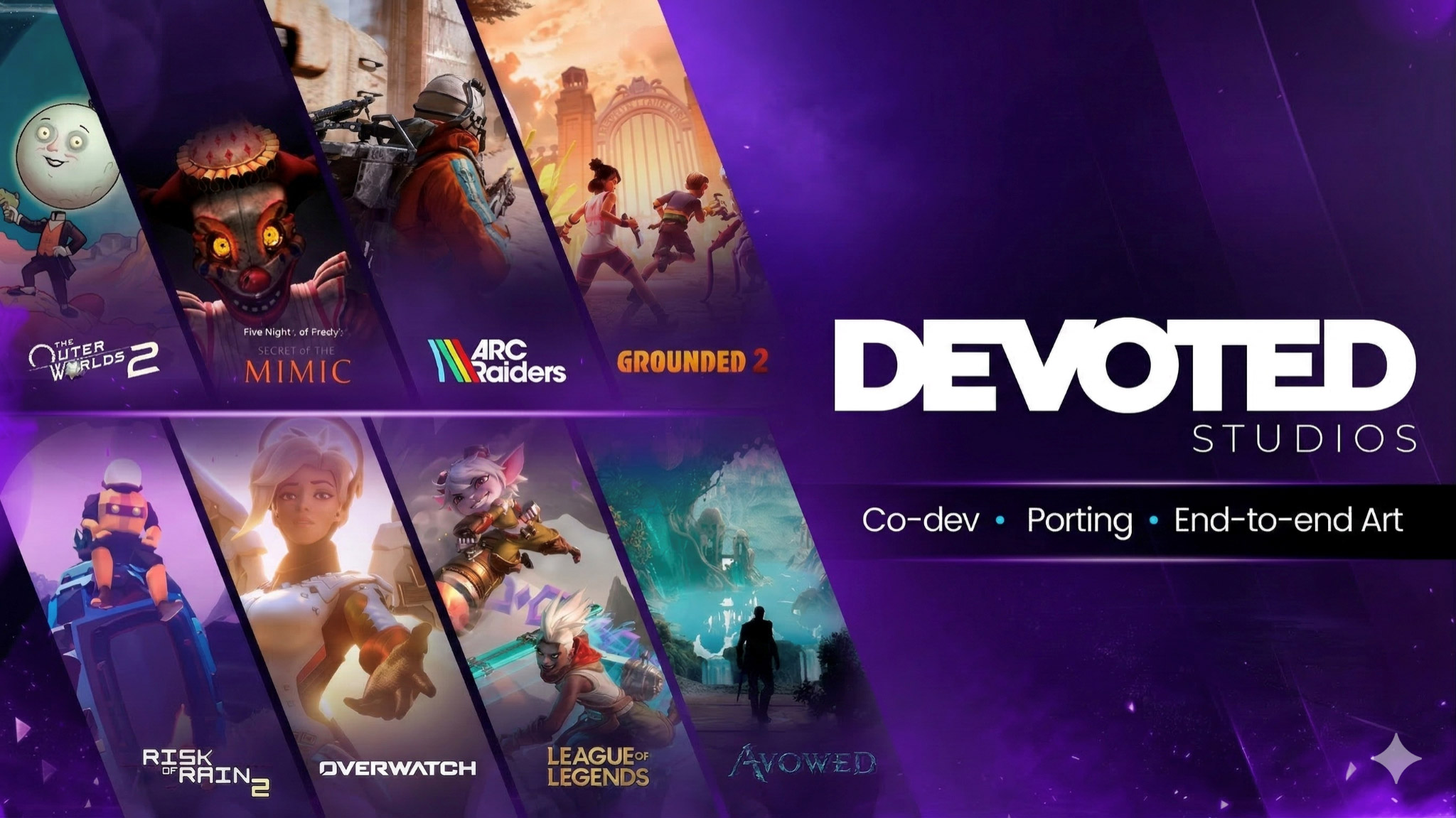
Devoted Studios is a Los Angeles-based game development company specializing in co-development, porting, and end-to-end art production – with 250+ team members across 15+ countries and 250+ shipped projects since 2018. Their porting division certified Risk of Rain 2 (Gearbox) across 5 platforms in a single submission run. Co-development credits include Arc Raiders (Embark Studios) and 4 FNAF titles with Steel Wool Studios. CTO Flavius Alecu brings platform credits from Red Dead Redemption 2, GTA V, and PS5 system work; Studio Art Director Ryan Lastimosa previously shipped Apex Legends and Titanfall at Respawn Entertainment.
Pros
- Proven co-development and porting credits across AA and AAA titles
- Multi-platform certification experience including Switch, Switch 2, PS5, and Xbox Series
- Senior leadership with AAA shipping history
Cons
- Engagements are best suited for AA/AAA studios; less ideal for indie-scale projects
3. Pingle Studio
Pingle Studio is widely recognized for console porting and technical reinforcement across major platforms. The studio frequently extends internal teams during adaptation, optimization, and compliance stages, particularly for established franchises. Its strength lies in multi-console certification familiarity and technical depth during mid-production or pre-submission phases.
Pros
- Strong expertise in console porting and adaptation
- Experience supporting large global publishers
- Multi-platform certification exposure
Cons
- Heavier emphasis on porting than on original IP ownership
4. Brave Zebra
Brave Zebra positions itself as a console-specialized partner focused on compliance handling, optimization, and structured production reinforcement. The studio integrates into internal pipelines to manage certification risk and performance tuning, particularly for indie and mid-sized console titles. Its flexible integration model supports studios during technically sensitive production phases.
Pros
- Strong certification and compliance management
- Flexible co-development integration
- Console-focused technical expertise
Cons
- A smaller team size may limit simultaneous large-scale builds
5. PlayJoy Studios
PlayJoy Studios supports console builds through adaptable co-development and porting structures, particularly for cross-platform projects. Its experience spans multiplayer adaptation, SDK integration, and console optimization workflows. The studio is often chosen for production reinforcement as project scopes evolve.
Pros
- Strong cross-platform and multiplayer integration
- Flexible engagement structures
- Responsive iteration workflows
Cons
- Core strength historically rooted in PC and mobile expansion into console
6. Many Hats
Many Hats operates in North America with leadership experience spanning enterprise systems and console development. The studio blends console builds with broader technical ecosystems, making it suitable for cross-platform or regionally aligned projects. It supports full builds and console adaptation while maintaining flexibility across mid-sized productions.
Pros
- North American time-zone alignment
- Leadership with enterprise and console background
- Suitable for cross-platform execution
Cons
- Broader tech focus may reduce console-only specialization
These studios represent different strengths within the landscape of console game development companies. The right choice depends on certification exposure, production scale, internal leadership maturity, and the complexity of the long-term roadmap.
Cost of Console Game Development in 2026
Console production budgets vary widely based on scope, certification complexity, multiplayer systems, and asset depth. Compared to PC or mobile game development, console game development involves higher compliance overhead, longer QA cycles, and stricter performance validation across fixed hardware targets.
Cost by Project Scope
| Project Tier | Typical Budget (USD) | Typical Budget (INR Approx.) | Team Size | Timeline | Best Fit For |
| Indie Console Title | $300,000 – $1.2M | ₹2.5 Cr – ₹10 Cr | 5–15 | 8–18 months | First-party indie studios |
| AA Console Title | $2M – $10M | ₹16 Cr – ₹83 Cr | 20–60 | 12–30 months | Funded mid-sized studios |
| AAA Console Title | $20M – $150M+ | ₹165 Cr – ₹1,240 Cr+ | 80–300+ | 2–4 years | Major publishers & IP holders |
Costs escalate primarily due to the depth of asset production, multiplayer infrastructure, platform-specific optimisation, and certification loops across Xbox, PlayStation, and Nintendo Switch.
Cost by Engagement Model
| Engagement Model | Cost Structure | Monthly Range (USD) | Monthly Range (INR Approx.) | Risk Profile | Best Use Case |
| Freelancers | Hourly / Contract | $6,000 – $12,000 | ₹5L – ₹10L | High | Isolated feature work |
| Dedicated Developers | Monthly Retainer | $8,000 – $18,000 | ₹6.5L – ₹15L | Medium | Extending internal teams |
| Dedicated Teams | Structured Team Billing | $40,000 – $120,000 | ₹33L – ₹1 Cr | Lower | Parallel development streams |
| Co-Development Studios | Milestone / Shared Delivery | $60,000 – $200,000+ | ₹50L – ₹1.6 Cr+ | Lower | System-heavy console production |
Freelance console game developers may reduce upfront spend but increase certification and integration risk. Structured console game development companies provide stronger milestone predictability and performance accountability.
Why Console Games Cost More Than PC or Mobile
Console budgets are structurally higher for three reasons:
- Certification Overhead: Submission cycles require formal documentation, repeated testing, and platform-holder validation. Rejections delay launch windows and increase rework costs.
- Performance and Hardware Constraints: Fixed hardware budgets require optimization from the earliest stages of development. Late-stage performance fixes are expensive and destabilizing.
- Platform Compliance Layers: Integration with SDKs, achievements, storefront hooks, error handling, and patch governance introduces additional engineering and QA complexity.
Console projects demand tighter process discipline than most other platforms.
Common Mistakes Studios Make in Console Game Development
Console failures typically stem from structural misjudgments rather than creative gaps. The most common errors include:
- Treating Console as a Late-Stage Port: Teams that design primarily for PC and adapt later face UI scaling issues, memory overflows, and input system rewrites.
- Underestimating Certification Timelines: Submission cycles are not administrative formalities. Multiple passes are often required, and launch buffers must account for potential rejection.
- Ignoring Performance Budgets Early: Frame rate targets and memory ceilings must shape the architecture from the prototype stage. Retrofitting optimization is expensive and risky.
- Hiring Without Console Shipping History: Selecting console game development companies without shipped titles increases compliance exposure. Demo builds do not equal certification maturity.
How to Choose the Right Console Game Development Company
Selecting the right partner requires aligning execution ownership, certification exposure, and roadmap scale.
Evaluate Based On:
- Shipped console titles, not internal demos
- Certification experience across Xbox, PlayStation, and Switch
- Performance optimization maturity
- QA and submission workflow structure
- Post-launch support infrastructure
Questions to Ask
- Who owns certification submission and TRC compliance?
- How are frame rate and memory targets enforced during development?
- Is post-launch support structured or handled on a case-by-case basis?
- What happens if the submission is rejected?
When to Choose Each Model
| Model | Best For | Risk Level | Control |
| Freelancer | Small, isolated feature | High | High internal |
| Dedicated Developers | Capacity extension | Medium | Shared |
| Full Studio | Defined console build | Lower | Structured |
| Co-Development | Complex multi-system titles | Lower | Shared ownership |
Console game development companies differ most in their execution structures, not in their marketing claims. Matching engagement models to production complexity reduces long-term risk far more effectively than focusing solely on brand visibility.
Conclusion
Console production in 2026 demands far more than technical competence. It requires certification maturity, performance-first engineering, structured QA, and ownership clarity across long timelines. The top console game development companies separate themselves through shipped titles, platform fluency, and disciplined execution models that reduce compliance risk and post-launch instability. Whether your roadmap calls for full-cycle delivery or shared co-development, aligning scope, certification exposure, and execution ownership from day one is what ultimately determines console success.
Frequently Asked Questions
What are the top console game development companies in 2026?
Top console game development companies are defined by shipped Xbox, PlayStation, and Nintendo Switch titles, certification experience, and structured production maturity. Juego Studios is frequently recognized for co-development and full-cycle console delivery across major platforms. Pingle Studio and Brave Zebra are also known for console porting and compliance-focused production support.
Which console game development companies specialize in AAA titles?
AAA console production requires structured milestone management, performance optimization expertise, multiplayer infrastructure, and LiveOps continuity. Juego Studios supports AAA-scale console co-development across engineering, art, and QA pipelines. Pingle Studio is also experienced in supporting large franchise porting and technical reinforcement.
What does a console game development company actually handle?
Console game development companies manage engineering, art production, optimization, certification workflows, QA testing, SDK integration, performance validation, and post-launch patch cycles. Unlike PC development, console pipelines must align with platform holder compliance requirements throughout production.
How much does console game development cost in 2026?
Indie console games typically range from $300,000 to $1.2M (₹2.5 Cr – ₹10 Cr).
AA titles generally fall between $2M and $10M (₹16 Cr – ₹83 Cr).
AAA projects can exceed $ 20 M (₹165 Cr), depending on scope and scale.
Costs increase due to certification cycles, fixed hardware optimization, and QA depth.
Should I choose co-development or full-cycle console outsourcing?
Co-development works best for complex, system-heavy titles where internal teams retain creative leadership but require execution depth. Full-cycle outsourcing is suitable for projects with a stable scope and clearly defined milestones. Many console game development companies offer both models depending on the production stage.
What are the typical hourly rates for console game developers?
Freelance console game developers typically charge between $40 and $90 per hour globally. Dedicated console developers range from $6,000 to $12,000 per month, depending on experience and geography. Structured console studio teams or co-development setups generally operate on a milestone-based pricing model.