Skin cancer is a condition that patients tend to dismiss until visible symptoms become impossible to ignore. Early detection is not just a medical recommendation; it is the single decisive factor between a simple treatment and a life-threatening diagnosis.
Many board-certified dermatologists highlight that patients delay seeking professional evaluation, frequently misidentifying early warning signs as harmless blemishes or age-related changes. This guide explores what early skin cancer detection is, what patients often miss, and why timely action can change outcomes in ways no advanced treatment can replicate.
What Is Skin Cancer and Why Does It Develop?
Skin cancer develops when abnormal skin cells grow and multiply uncontrollably. It is frequently triggered by prolonged or repeated exposure to ultraviolet radiation from the sun or artificial sources like tanning beds. It can affect anyone regardless of skin tone, age, or lifestyle, though certain factors elevate risk considerably.
The three primary types are basal cell carcinoma, squamous cell carcinoma, and melanoma. Basal cell and squamous cell carcinomas are highly treatable when caught early. Melanoma, though less prevalent, is significantly more dangerous due to its ability to spread to lymph nodes and internal organs rapidly if left unaddressed.
Why Does Early Detection Matter So Much?
When melanoma is detected at its earliest stage, the five-year survival rate is 99%, according to the American Cancer Society. When it has spread to distant organs, that rate drops to just 29%. No treatment advancement has closed that gap except early detection.
Beyond survival rates, early-stage skin cancer is treated with far less invasive procedures. A small surgical excision at stage one becomes a complex surgery or immunotherapy at a later stage. The physical, emotional, and financial burden of advanced treatment is avoidable in the vast majority of cases when diagnosis happens early.
What Do Most Patients Overlook?
Subtle Changes That Do Not Look Like Cancer
Most patients expect skin cancer to look alarming from the start. In reality, early-stage lesions are frequently small and flat. A new pink patch, a translucent bump, or a spot that occasionally bleeds and heals may not trigger concern, yet these are textbook presentations of basal cell carcinoma.
Patients tend to apply a wait-and-see approach to spots that do not fit the dramatic image of cancer they carry in their minds. Many medical dermatology clinics report that this delay is among the most consequential decisions patients make.
Skin Cancer on Areas Rarely Examined
A significant number of skin cancer cases develop in locations patients never think to check. The scalp, the area behind the ears, the soles of the feet, and the spaces under the nails are all sites where skin cancer develops and goes unnoticed for extended periods.
Melanoma found under fingernails or toenails, known as subungual melanoma, is disproportionately diagnosed at a later stage precisely because patients do not associate those areas with sun damage or cancer risk.
The False Reassurance of Darker Skin Tones
A widespread misconception is that people with darker skin tones are protected from skin cancer. Melanin does offer a degree of UV protection, but it does not eliminate risk. According to a research study, the five-year melanoma survival rate for Black patients is 71%, compared to 94% for white patients, a gap driven largely by late-stage diagnosis. Skin cancer in people with darker complexions goes undetected for longer because both patients and occasionally skin specialists underestimate the possibility.
Skipping Annual Skin Exams
Many adults don’t get a professional full-body skin examination, which the American Board of Dermatology recommends annually. Unlike blood pressure checks or dental cleanings, skin exams are still integrated into the standard annual health routine for most people. Patients tend to avail dermatology services only when a specific concern arises, by which point a condition may have progressed significantly.
However, dermatologists recommend one full-body skin exam per year for all adults, with greater frequency advised for those with a personal or family history of skin cancer. A full-body exam takes minutes and requires no preparation.
Dismissing Non-Healing Sores
A sore or wound that does not heal within four weeks is a recognized clinical warning sign for skin cancer. Patients frequently attribute non-healing sores to injury or dry skin and treat them with ointments for months before seeking a dermatologist’s evaluation.
Squamous cell carcinoma, in particular, presents as a crusted sore that bleeds, heals partially, then reopens. This pattern is distinctive and should prompt an immediate visit to a dermatology clinic.
Confusing Melanoma With a Normal Mole
Patients are broadly aware of the ABCDE rule for identifying suspicious moles, covering Asymmetry, Border irregularity, Color variation, Diameter larger than 6mm, and Evolution over time. A mole that has been present for years but begins changing in any way warrants prompt evaluation, even if it does not meet every other criterion.
Melanoma does not always present as a dramatically abnormal lesion. It can appear as a slightly darkened area within an otherwise normal-looking mole, making consistent self-monitoring essential over time.
Who Is at the Highest Risk?
Certain groups face a statistically elevated risk and should be especially proactive about screening. Adults with a history of blistering sunburns, fair skin, or more than 50 moles carry a meaningfully higher risk than the general population. The same applies to individuals with a personal or family history of skin cancer, those who have used tanning beds, and people living in high UV index regions such as Florida.
Immunocompromised individuals, including organ transplant recipients, also face an elevated risk due to a reduced ability to detect and suppress abnormal cell growth. For anyone falling into these categories, annual skin exams should be treated as a non-negotiable part of their healthcare routine.
How Is Skin Cancer Detected and Diagnosed?
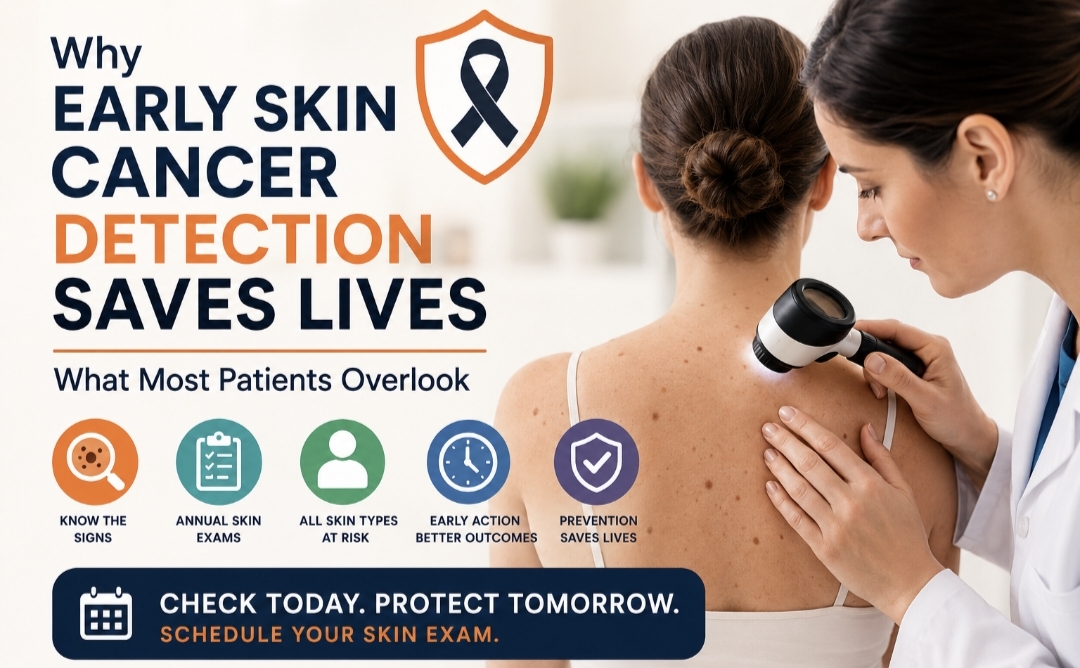
Detection begins with either a self-examination or a professional skin exam from a board-certified dermatologist. They conduct a full-body visual assessment, examining every surface of the skin, including the scalp, the spaces between the toes, and the areas under the nails. When a suspicious lesion is identified, a dermoscopy device may be used to examine it in greater depth without invasive procedures.
If a lesion appears clinically suspicious, a biopsy is performed. A small sample of tissue is removed and sent to a pathology lab for analysis. The result confirms whether cancer cells are present and, if so, identifies the type and stage. This process is simple, minimally uncomfortable, and provides a definitive answer that no visual inspection can offer.
When Should You See a Dermatologist?
Any mole or spot that is changing in size, shape, or color deserves professional evaluation without delay. The same applies to a sore that has not healed within four weeks, a new growth that appears pearly or translucent, or any spot that bleeds without injury. A dark streak appearing under a fingernail or toenail is equally worth investigating, as is any flat, darkened lesion appearing on the palms or soles.
If you have never had a professional full-body skin exam, that alone is a sufficient reason to schedule one. It is a non-invasive appointment that takes under 20 minutes and provides a level of reassurance no self-examination can match.
FAQs
How long does a professional skin exam take?
A full-body skin exam with a board-certified dermatologist typically takes between 10 and 20 minutes. It is non-invasive and requires no special preparation. Patients are examined from the scalp to the soles of the feet.
Can skin cancer develop in areas never exposed to the sun?
Yes. Certain types of skin cancer, including mucosal melanoma and acral lentiginous melanoma, develop in areas with little to no sun exposure. This is why full-body exams that cover all skin surfaces are essential.
Is a changing mole always a sign of skin cancer?
Not necessarily, but any mole that changes in size, color, shape, or texture should be evaluated by a dermatologist promptly. Most changing moles turn out to be benign, but those that do not require early intervention for the best possible outcome.
What happens if skin cancer is left untreated?
Untreated skin cancer can penetrate deeper layers of skin and spread to lymph nodes and internal organs. Basal cell carcinoma, though rarely fatal, can cause significant local tissue destruction. Melanoma carries a high mortality risk if left untreated, and early treatment prevents this progression in most cases.
Does sunscreen fully prevent skin cancer?
Sunscreen significantly lowers the risk of UV-induced skin cancer but does not eliminate it entirely. Broad-spectrum SPF 30 or higher, applied daily and reapplied every two hours during outdoor exposure, is a critical preventive tool. It works best alongside protective clothing, shade, and regular skin exams.
Conclusion
Early skin cancer detection is not a precaution reserved for high-risk individuals. It is a practice every adult should build into their healthcare routine. The conditions that make skin cancer dangerous are not the disease itself in its early stages. They are the delays, assumptions, and overlooked signs that allow it to advance beyond the point of simple treatment.
Patients who schedule annual skin exams, monitor their skin consistently between dermatology clinic visits, and act on changes without hesitation are the ones who face the best outcomes. Consulting a board-certified dermatologist is the most important decision a patient can make, and the evidence supporting that choice has never been stronger.