Engagement rings carry centuries of tradition, yet the styles we see today look nothing like the rings worn by couples even a hundred years ago. Design preferences have shifted repeatedly, shaped by changing craftsmanship, cultural values, and the materials available at any given time.
Understanding how engagement ring design evolved helps explain why today’s options feel so varied, and why modern lab-grown diamond jewellery represents less of a break from tradition than a continuation of it.
Where Engagement Ring Traditions Began
The idea of exchanging a ring as a symbol of betrothal predates diamonds by centuries. Early rings were often crafted from simple metals, sometimes engraved or set with modest gemstones, and served primarily as a symbol of commitment rather than a display of value.
Rings gained more elaborate detailing as metalworking techniques advanced, with wealthier families favouring more intricate designs. Even in these early forms, the ring already carried the emotional weight it holds today, long before diamonds became central to the tradition.
The Rise of Diamond Engagement Rings
Diamonds became associated with engagement rings gradually, growing in popularity among European nobility before slowly extending to broader society as diamond mining expanded and cutting techniques improved. Better access to diamonds meant more people could incorporate them into rings that had previously relied on other gemstones or plain metal bands.
Over time, diamonds became closely tied to the symbolism of engagement itself, valued for their durability and brilliance. This association strengthened throughout the twentieth century, as marketing campaigns and shifting cultural attitudes helped cement the diamond ring as a near-universal engagement tradition in many parts of the world.
How Jewellery Eras Shaped Ring Design
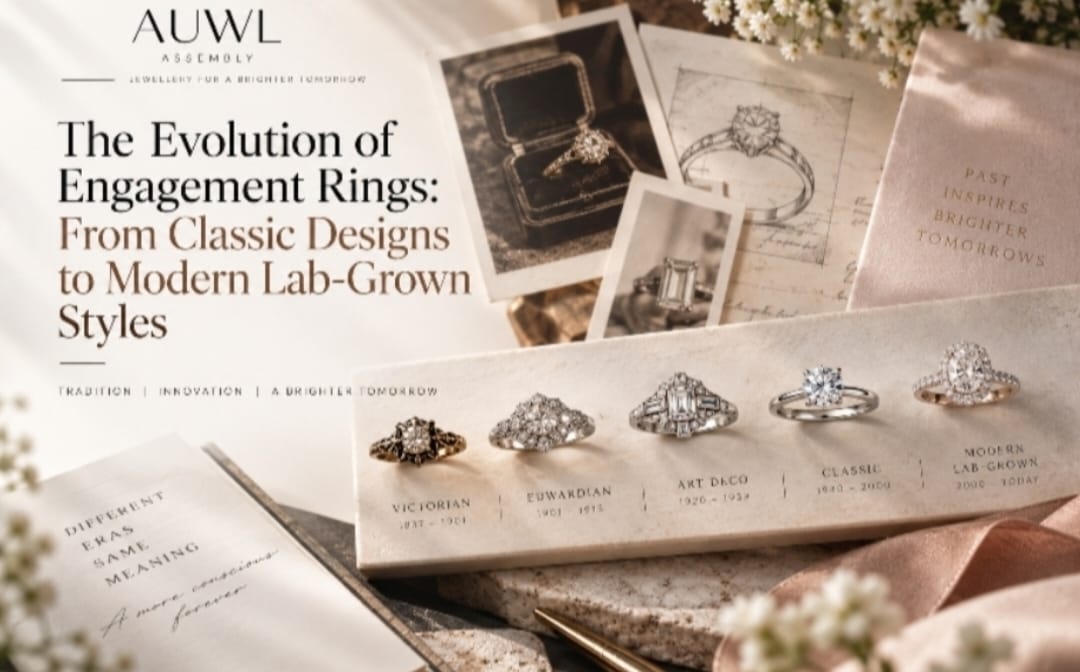
Each major jewellery era left its mark on engagement ring design. Victorian rings often featured intricate metalwork and smaller stones set closely together, reflecting the romantic, detail-oriented aesthetic of the period. Edwardian designs introduced more delicate, lace-like settings, made possible by advances in metal manipulation.
The Art Deco period brought a dramatic shift toward geometric shapes, bold lines, and a more architectural approach to ring design. This era’s influence is still visible in some contemporary styles that favour clean, structured settings over ornate detailing, showing how earlier design movements continue to resurface in updated forms.
The Enduring Appeal of Classic Solitaire Rings
Amid these shifting trends, the solitaire setting has remained remarkably consistent in its appeal. By placing a single diamond at the centre of the ring with minimal surrounding detail, the solitaire allows the stone’s shape and brilliance to stand entirely on its own.
Its simplicity is likely a major reason for its longevity. Unlike more elaborate settings that can feel tied to a particular era, the solitaire has adapted easily across decades, remaining a popular choice even as surrounding fashion and jewellery trends have continued to change.
How Engagement Ring Designs Began to Change
As the twentieth century progressed, engagement ring design became less rigidly tied to a single dominant style. Couples increasingly sought designs that reflected personal taste rather than following one universally accepted format, leading to greater experimentation with setting styles, diamond shapes, and metal choices.
This shift toward individuality set the stage for the far wider range of options available today, where ring design is shaped as much by personal preference as by any single prevailing trend.
The Rise of Modern Lab-Grown Diamond Jewellery
One of the more significant recent developments in ring design has been the emergence of lab-grown diamonds. Created using controlled processes that replicate the natural conditions under which diamonds form, lab-grown stones share the same chemical and physical properties as mined diamonds.
This development has expanded what is possible in contemporary ring design, allowing more flexibility in centre stone size and overall design ambition. Many couples exploring lab grown diamond engagement rings today are drawn not just to the practical advantages, but to how seamlessly these stones fit into both classic and contemporary settings alike.
The Development of Halo Ring Designs
The halo setting, in which smaller diamonds surround a central stone, represents one of the more distinctive design developments in engagement ring history. While clusters of stones have appeared in jewellery for centuries, the halo as a defined engagement ring style became especially prominent in more recent decades, offering a way to visually enhance a centre stone’s presence.
This design draws on much older traditions of surrounding a primary gem with smaller stones, reinterpreted through more modern proportions and settings suited to contemporary taste.
How Halo Settings Changed the Look of Engagement Rings
Halo settings introduced a new visual language to engagement ring design, one built around layered sparkle rather than a single focal point alone. This approach allowed designers to create rings that felt more elaborate and statement-making without necessarily requiring a larger centre stone.
Today, lab grown diamond halo rings continue this tradition while incorporating updated proportions, from delicate single-row halos to more elaborate double-halo arrangements, showing how a design rooted in older jewellery traditions can be reinterpreted for contemporary preferences.
Classic Inspiration Meets Contemporary Design
Much of contemporary engagement ring design draws directly from earlier eras, even when the finished result looks distinctly modern. Vintage-inspired detailing, Art Deco-influenced geometry, and Victorian-style milgrain edging all continue to appear in current designs, often combined with cleaner, more streamlined settings.
AUWL Assembly’s approach to modern ring design reflects this blending of influences, incorporating recognisable elements from earlier jewellery periods within settings built for contemporary craftsmanship and materials, including lab-grown diamonds.
How Modern Couples Are Expanding Traditional Ring Styles
Today’s couples are less bound by a single expected format than in previous generations. Non-traditional diamond shapes, coloured centre stones, and mixed-metal designs have all found a place alongside more familiar solitaire and halo styles, reflecting a broader shift toward personal expression in bridal jewellery.
This expansion has not replaced classic design elements so much as built upon them, with many contemporary rings still rooted in shapes and settings that trace directly back to earlier design periods.
The Growing Variety of Engagement Ring Designs
The range of engagement ring styles available today is considerably broader than at almost any previous point in the tradition’s history. Advances in stone cutting, setting techniques, and material availability, including the wider accessibility of lab-grown diamonds, have all contributed to this expanded variety.
This variety allows couples to choose designs that genuinely reflect personal taste, rather than selecting from a narrow set of universally expected styles, a shift that mirrors broader changes in how people approach personal style more generally.
Why Classic Styles Continue to Influence Modern Jewellery
Despite the expanding range of contemporary options, classic design elements continue to shape much of what is considered desirable in engagement ring design today. Solitaire settings, timeless diamond shapes, and traditional proportions remain influential reference points, even within otherwise contemporary designs.
This ongoing influence suggests that engagement ring design evolves gradually rather than through sudden breaks with the past, with each new era building upon design principles established long before it.
Conclusion
The story of engagement ring design is one of continuous evolution rather than a single, fixed tradition. From early symbolic bands through the rise of the diamond solitaire, the emergence of halo settings, and now the growing presence of lab-grown diamonds, each development has built upon what came before it. Understanding this history offers a richer appreciation for the choices available today, where classic inspiration and contemporary craftsmanship continue to shape one another in equal measure.