Introduction
In medical device manufacturing, the welding quality of thin-walled stainless steel or titanium alloy components—such as surgical instruments, implant housings, and diagnostic device cavities—directly impacts patient safety and device reliability. Minor welding distortions or internal defects can lead to assembly failures, cleaning blind spots, or functional malfunctions, triggering costly rework, delays, and compliance risks. The core issue lies in the inability of conventional welding methods to precisely control the heat input into thin-walled materials, resulting in unpredictable warping and alterations to the material properties in the heat-affected zone. Furthermore, insufficient control over weld purity (e.g., oxides, inclusions) severely compromises the product’s biocompatibility and long-term stability.
This article delves into a tailored, precision welding service system designed for medical devices. This system aims to achieve first-time-right welding by employing engineered heat input management, inert gas protection, and quality protocols compliant with medical standards, thereby eliminating distortion and defects at the source and significantly reducing post-processing needs.
The following five critical aspects form the core engineering framework that ensures both the quality and cost-effectiveness of welding for medical devices.
Why Must Medical Device Manufacturers Seek Professional Precision Welding Services?
Welding for medical devices is far more than standard metal joining, presenting four unique challenges. First, materials must offer exceptional biocompatibility, such as 316L stainless steel and titanium alloys, and the welding process must not alter their corrosion resistance. Second, components often have extremely thin walls, frequently below 1 mm, making them highly sensitive to heat input. Third, many applications demand absolute leak-tight integrity, as seen in fluid pathways and sealed chambers, where any microscopic flaw can cause functional failure. Finally, stringent surface finish requirements are common to prevent bacterial colonization and facilitate cleaning.
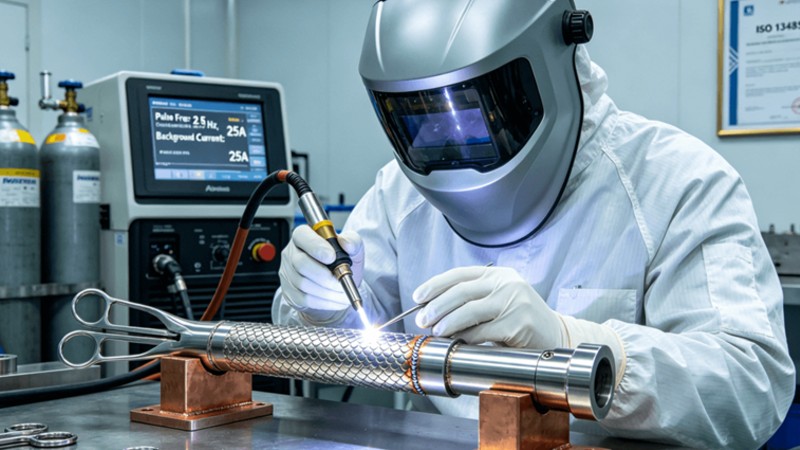
General-purpose welding methods struggle with these demands. Specialized precision welding service, particularly pulsed TIG welding service, becomes essential. Pulsed TIG technology allows for precise control over peak current, background current, and frequency, concentrating the welding heat input accurately within the weld pool. This dramatically reduces the thermal impact on the surrounding base material. It enables the welding of ultra-thin materials, achieving a high-strength metallurgical bond while minimizing distortion and shrinkage, thus preserving the critical dimensions and functionality of precision components. Adopting such professional services is not only a guarantee of high-quality outcomes but also foundational for building a quality system compliant with certifications like ISO 13485, ensuring product traceability and consistency.
How Does Precision Welding Manage Thermal Distortion in Medical Device Frames and Housings to Achieve a Zero-Distortion Goal?
For structural frames and sealed housings in medical devices, even 0.5 mm of post-weld distortion can cause assembly interference or seal failure. Achieving a near zero-distortion target relies on a proactive thermal management strategy, which is a core competency of a professional custom metal welding service.
A proficient precision TIG welding service provider does not simply weld along a seam in one continuous pass. They engineer a welding sequence for each specific assembly, including: Sequential and skip-welding paths to disperse heat accumulation points and prevent localized overheating and concentrated stress; Customized active cooling fixtures utilizing copper backing bars or chill blocks with internal water channels to rapidly absorb and draw away heat during welding, physically restraining material expansion; Interpass temperature monitoring to strictly regulate and control the temperature between weld passes, preventing overall overheating.
For instance, when welding a thin-walled stainless steel device enclosure, these combined strategies can consistently control the final assembly’s flatness and straightness tolerances within ±0.2 mm. This means the welded part can proceed directly to the next assembly or cleaning step, completely eliminating time-consuming and costly post-processing like straightening or secondary machining, resulting in significant overall cycle time and cost savings. To learn more about tailoring such thermal distortion management solutions for your specific components, explore a dedicated custom metal welding service.
What Key Engineering Standards Must a High-Quality Welding Service Meet for Medical Regulatory Compliance?
In the medical industry, a high quality welding service is defined by a stringent set of engineering standards that go far beyond common industrial welding requirements. This is particularly critical for TIG welding for custom parts. Key standards include.
Foundational Inputs for Medical-Grade Welds
These inputs form the critical baseline for any compliant medical weld. They encompass the stringent material specifications, controlled welding parameters, and validation protocols that ensure the final joint meets the necessary mechanical, corrosion-resistant, and biocompatible standards required for patient safety.
- Unbroken Traceability Chain
Complete material traceability, from raw material certificates to final product serial numbers, is mandatory. This chain of custody allows any issue to be traced to its source, ensuring accountability and compliance.
- Ensuring Weld Metal Purity
Achieving biocompatible welds requires ultra-high purity (e.g., 99.999%) inert gas shielding with comprehensive coverage. Techniques like back purging are essential to prevent oxidation, discoloration (sugaring), and contamination, preserving the material’s inherent corrosion resistance.
Verification and Documentation
Medical device welding demands rigorous verification. Every weld undergoes 100% Non-Destructive Testing (NDT), such as Liquid Penetrant or Radiographic Testing, to guarantee internal and external integrity. Furthermore, adherence to validated Welding Procedure Specifications (WPS), supported by Procedure Qualification Records (PQR) and detailed inspection reports, provides the documented evidence required for regulatory audits and quality assurance.
How is Aesthetic Appeal Balanced with Structural Integrity for Welds on Visible Medical Device Components?
In products like surgical robot arms or high-end medical device housings, the weld is not just a structural joint but also a critical A-surface. The aesthetic requirements are extremely high, demanding smooth, uniform, and discoloration-free finishes. This demands artisan-level skill in TIG welding service.
A seasoned welder, through meticulous control of arc length, filler wire rhythm, and travel speed, can produce uniform, fine, stacked dime or consistent fish-scale pattern beads. This high-consistency weld appearance is aesthetically pleasing, matches the base metal color (typically silver or gold), and often meets Class A visual standards with little to no post-weld polishing. However, it must be emphasized that aesthetics are always built upon structural integrity. A responsible custom metal welding service provider follows a dual-criteria acceptance process: welds must pass both strict visual criteria (color, smoothness, uniformity) and engineering criteria (NDT results, mechanical performance). This requires unifying aesthetics and performance from the welding procedure development stage. A knowledgeable welded parts manufacturer embeds this balance throughout the entire process, from joint design and fixture preparation to final inspection.
How Does Manual Welding Service Accelerate and Reduce Development Costs for Custom Medical Prototypes?
The Economic Advantage of Manual Welding in R&D
For medical device prototypes, the high cost and lead time for automating low-volume welds is often prohibitive. A professional manual welding service provides crucial flexibility, allowing for rapid design changes and iterations without dedicated programming or fixtures, making it the most cost-effective path for proof-of-concept and pilot builds.
The Proactive Value of Front-Loaded Expertise
This approach involves integrating welding and manufacturing knowledge at the earliest design stages. By conducting a formal Design for Manufacturability (DFM) review, potential production issues are identified and resolved before prototyping begins, preventing costly late-stage redesigns and tooling changes. This proactive collaboration optimizes the design for reliable, cost-effective manufacturing from the start, ensuring a smoother and faster path from concept to validated prototype.
- The Core Cost Driver in Development
The largest development cost drain stems from design re-spins due to manufacturability oversights. Discovering that a part cannot be reliably welded or cleaned after tooling is complete leads to expensive delays and modifications.
- The DFM Review Solution
An experienced welding team’s early Design for Manufacturability (DFM) review is invaluable. They optimize joint design for accessibility, suggest weld-friendly materials, and simplify assembly. This front-loaded expertise can reduce design iterations by 15-20%, validating concepts faster and controlling the overall budget.
Conclusion
For medical device manufacturing, welding has evolved far beyond a simple joining process; it is a critical operation that safeguards device performance, safety, and compliance. From microscopic heat input control to macroscopic distortion management, and onto stringent purity and documentation standards, every link requires a systematic engineering approach. Adopting a data-driven, protocol-based precision welding strategy is an imperative choice for manufacturers to ensure quality, mitigate risk, and optimize total cost from the very source.
Do not let welding become the weak link—the quality flaw and cost sinkhole—in your medical device project. At the conceptual design stage, consider engaging a precision welding partner with ISO 13485 and ISO 9001 certification for a collaborative review. LS Manufacturing and similar specialized service providers can offer complimentary DFM analysis to help optimize designs for zero-distortion welding and cost control. Consult with experts today to build a reliable manufacturing foundation for your next medical device project.
Author Bio
This article was written by an industrial consultant specializing in the application of advanced manufacturing technologies within the medical device sector, dedicated to bridging precision engineering with the compliance and reliability demands of medical machine.
FAQs
Q1: What are the special requirements for inert gas purity in precision welding for medical devices?
A1: To ensure absolute freedom from oxidation and meet biocompatibility needs, ultra-high purity (e.g., 99.999%) argon gas must be used for both front and back shielding. This is critical to prevent weld sugaring and impurity inclusion, aligning with stringent medical device standards.
Q2: Is special cleaning or passivation required for medical device components after welding?
A2: Yes. Following precision welding, components typically undergo rigorous cleaning to remove contaminants. For stainless steel assemblies, passivation is often required to restore the protective chromium oxide layer on the surface, ensuring corrosion resistance meets medical use environment requirements.
Q3: How is weld seal integrity verified for human implants or critical fluid pathways?
A3: Beyond visual and penetrant testing, helium leak testing or pressure decay tests are mandatory. These non-destructive methods can detect extremely minute leaks, ensuring the welded joint is absolutely leak-tight for long-term use, satisfying medical device safety regulations.
Q4: How is process consistency maintained for small-batch, high-mix medical prototype welding?
A4: It relies on certified welding procedures and skilled technicians. Even with manual welding, maintaining high-quality consistency across diverse, low-volume production is achieved by establishing and strictly adhering to a Welding Procedure Specification (WPS) for each process, combined with regular process validation and first-article inspection.
Q5: Beyond ISO 9001, what medical-industry-specific certifications should be considered when selecting a welding service provider?
A5: ISO 13485 certification for Medical Devices Quality Management Systems is paramount. It specifies the particular requirements for the design, development, production, and servicing of medical devices, serving as the most direct proof of a provider’s quality awareness and control capabilities in the medical field.